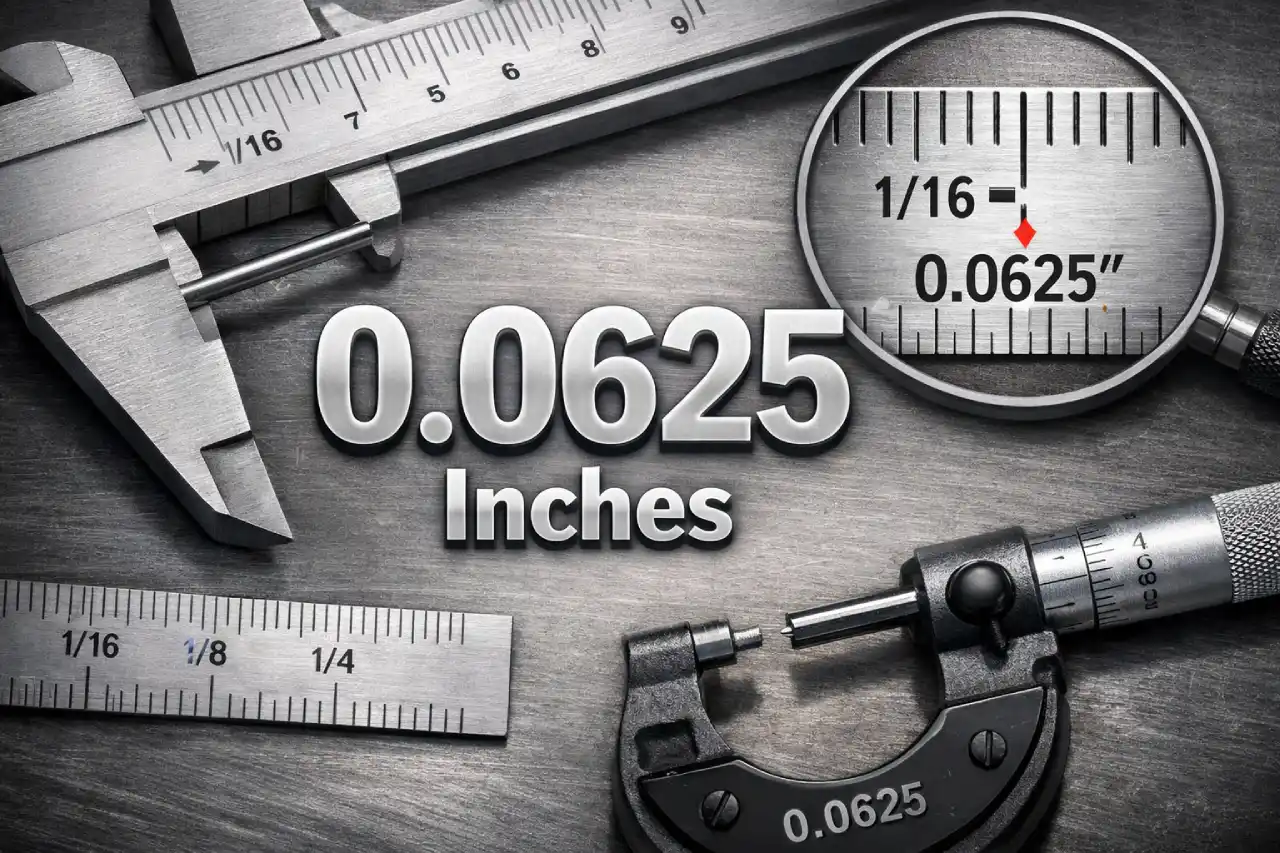
Let’s start with a satisfying fact right away.
0.0625 inches = 1/16 inch (exact)
No rounding. No approximation. No “close enough.”
If you’ve ever looked at a digital caliper, CAD file, or spec sheet and seen 0.0625, you were actually staring at one of the cleanest, friendliest measurements in the inch system. It just happens to be wearing a decimal disguise.
This article breaks down 0.0625 inches in a clear, practical way—what it means, why it shows up everywhere, how to spot it instantly on a ruler, and why it’s such a big deal in real-world measuring.
Why People Search for “0.0625 in Inches”
At first glance, the phrase sounds odd.
After all, 0.0625 is already in inches.
But people search this because they see 0.0625 inches in:
- Digital calipers
- Engineering drawings
- CAD and CNC files
- Machining specs
- Hardware measurements
Then they grab a ruler and suddenly realize something interesting.
0.0625 inches lines up perfectly with a common fraction.
Once you know which one, everything clicks.
What 0.0625 Inches Means in Plain English
Decimal inches divide one inch into hundredths or thousandths.
So technically:
0.0625 inches = sixty-two and a half thousandths of an inch
That’s accurate, but not very helpful.
What is helpful is this:
0.0625 inches = 1/16 inch
And this is an exact conversion, not an estimate.
Why This Conversion Is Perfectly Exact
Let’s look at the math behind it.
1 inch ÷ 16 = 0.0625 inches
That’s it.
There’s no rounding, no repeating decimals, and no approximation involved. That’s why 0.0625 inches shows up so often in digital tools—it’s the decimal form of 1/16 inch, one of the most common fractional measurements.
Why 1/16 Inch Is Everywhere
The fraction 1/16 inch is a workhorse measurement.
You see it constantly in:
- Woodworking
- Construction
- Hardware sizing
- DIY projects
- Mechanical parts
It’s small enough for reasonable precision, but large enough to measure easily with basic tools.
So when software converts 1/16 inch into decimal form, you get 0.0625 inches every single time.
Where 0.0625 Inches Falls on a Ruler
If you’re holding a ruler right now, this part is easy.
- Look at one inch
- Divide it into 16 equal parts
- Each small mark is 1/16 inch
That mark is 0.0625 inches.
No guessing. No estimating. It’s exactly where the ruler tells you it is.
Is 0.0625 Inches the Same as 0.06 Inches?
No—and this difference matters more than people expect.
0.06 inches = 6/100
0.0625 inches = 1/16
Difference:
0.0625 − 0.06 = 0.0025 inches
That might look tiny, but in precision work, it can matter.
So:
- 0.0625 inches is slightly larger than 0.06 inches
- They are not interchangeable
Is 0.0625 Inches the Same as 1/8 Inch?
Definitely not.
1/8 inch = 0.125 inches
0.0625 inches = 1/16 inch
That’s exactly half the size.
This mix-up usually happens when people forget how small sixteenths really are.
How Small Is 0.0625 Inches, Really?
To put it into perspective, 0.0625 inches is:
- About 1.59 millimeters
- Roughly the thickness of a nickel
- Slightly thicker than a credit card
- Clearly visible, but still a small measurement
It’s small—but very manageable with basic measuring tools.
Why 0.0625 Inches Shows Up So Often in Digital Tools
Decimal numbers like 0.0625 aren’t random.
They appear because:
- Computers love powers of two
- Sixteenths divide evenly into inches
- The math stays clean and exact
That’s why you’ll often see values like:
- 0.0625 (1/16)
- 0.125 (1/8)
- 0.1875 (3/16)
- 0.25 (1/4)
These decimals are just fractions in disguise.
Common Mistakes People Make With 0.0625 Inches
One common mistake is assuming 0.0625 inches is an approximation. It’s not.
Another mistake is rounding it to 0.06 inches, which introduces error.
Some people also confuse 0.0625 inches with 0.625 inches, which is ten times larger and completely different.
Decimal placement matters—a lot.
Fraction, Decimal, and Metric Together
Here’s how this measurement looks across systems.
- Fraction: 1/16 inch
- Decimal: 0.0625 inches
- Metric: 1.5875 mm
All three describe the same physical length.
Once you see them together, conversions stop feeling mysterious.
When to Use the Decimal vs the Fraction
Use 0.0625 inches when:
- Reading digital calipers
- Working in CAD or design software
- Writing technical specifications
- Doing calculations
Use 1/16 inch when:
- Measuring with a ruler
- Cutting materials
- Drilling holes
- Doing hands-on work
Switching between the two is a normal part of working with measurements.
Real-World Example
Imagine a slot specified as 0.0625 inches wide.
If you grab a 1/16 inch tool, you’ve chosen the correct size.
If you round it to 0.06 inches, the fit may be tighter than intended.
That’s why clean conversions like this are so valuable.
Why Clean Numbers Reduce Mistakes
Measurements like 0.0625 inches are friendly because:
- They convert exactly
- They measure cleanly
- They reduce guesswork
The more you recognize these values, the faster and more confident your measuring becomes.
A Quick Mental Check You Can Use
Any time you see 0.0625 inches, ask yourself:
Does this look like a power-of-two fraction?
If the answer is yes—and it is—you’re probably looking at 1/16 inch.
Quick Summary You Can Remember
Let’s lock it in clearly.
- 0.0625 inches = 1/16 inch (exact)
- One of the cleanest decimal-to-fraction conversions
- Easy to measure on any standard ruler
- Common in woodworking, construction, and machining
If you remember one thing, remember 1/16 inch.
Final Thoughts
Some measurements look strange until you understand where they come from.
0.0625 inches isn’t awkward at all—it’s simply 1/16 inch wearing a decimal suit. Once you recognize it, the number becomes familiar, friendly, and easy to work with.
And when measurements feel familiar, your work becomes faster, cleaner, and far more reliable.