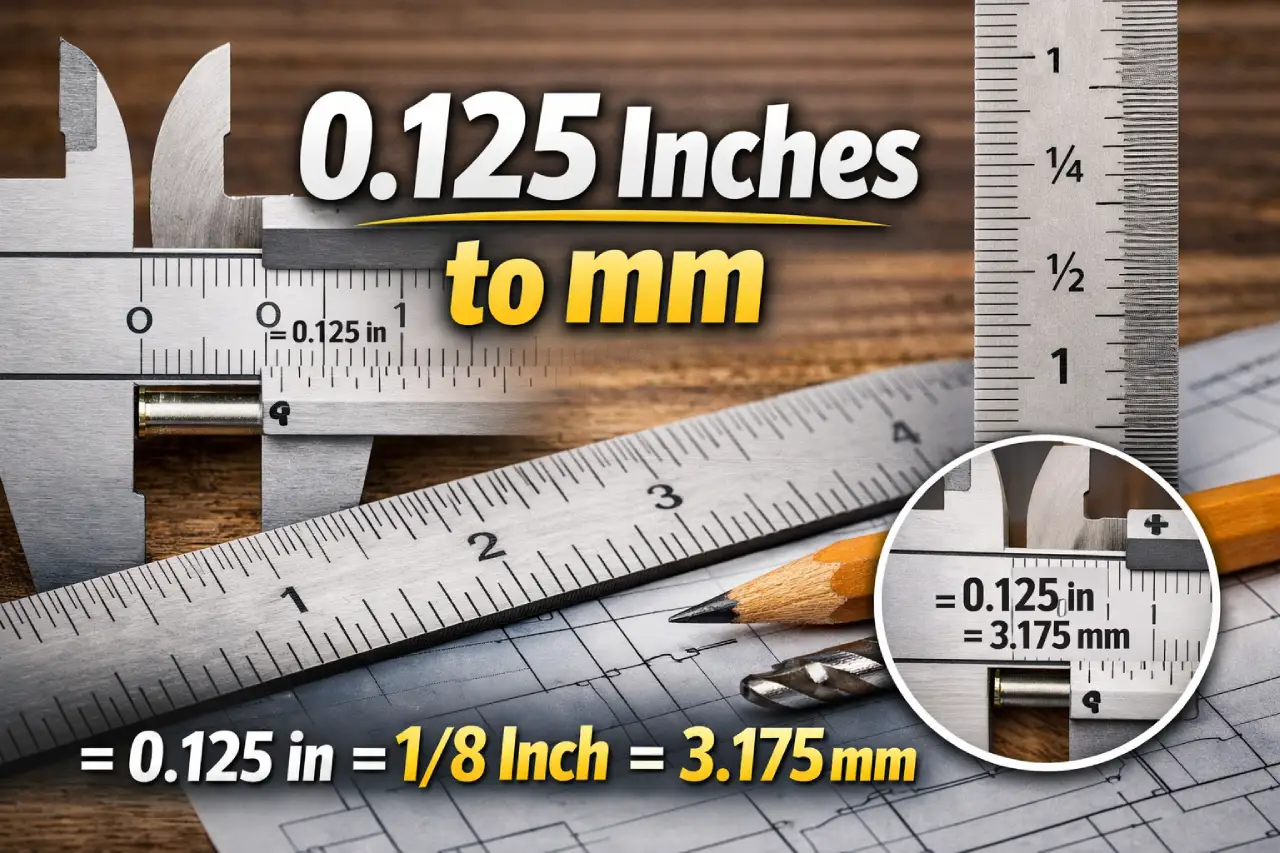
Let’s start with the clear, no-nonsense answer.
0.125 inches equals 3.175 millimeters (mm).
That’s the exact conversion. No rounding. No approximation. Just 3.175 mm, every single time.
Now, even though this looks like a very small number, 0.125 inches to mm is one of the most commonly searched conversions. It appears constantly in tools, hardware, machining, engineering, woodworking, electronics, and even 3D printing. And if you’ve ever paused mid-project to double-check what one-eighth of an inch is in millimeters, you’re definitely not alone.
Let’s break it down in a way that actually makes sense—and sticks.
What Does 0.125 Inches Really Mean?
At first glance, 0.125 inches looks like a random decimal. But it’s actually one of the simplest inch measurements you’ll ever deal with.
The Fraction Behind the Decimal
.125 inches is simply another way of writing 1/8 inch.
Here’s the relationship:
- 1/8 inch =0.125 inches
- 2/8 inch = 0.25 inches
- 4/8 inch = 0.5 inches
So when you see 0.125 on a spec sheet or drawing, just think one-eighth of an inch.
That single mental switch makes the number instantly familiar.
The Exact Conversion: 0.125 Inches to mm
Now let’s convert it properly using the global standard.
The official rule is:
1 inch = 25.4 millimeters
So the math looks like this:
0.125 × 25.4 = 3.175 mm
This value is exact. That’s why you’ll often see 3.175 mm listed in technical drawings, machining guides, and precision tools.
Why This Tiny Measurement Matters So Much
It’s easy to think, “It’s just one-eighth of an inch—how important can it be?”
The answer: very.
Common Places Where 0.125 Inches Is Used
- Drill bit sizes
- Sheet metal thickness
- Spacing in mechanical parts
- Electronic components
- Woodworking joinery
- CNC machining tolerances
- 3D printer nozzle and layer references
When measurements get this small, precision stops being optional.
Visualizing 0.125 Inches vs 3.175 mm
Numbers are helpful, but visuals make things click.
On an inch ruler:
- One inch is divided into eight equal parts
- The very first small mark after zero is 1/8 inch
- That mark equals 0.125 inches
On a metric ruler:
- 3 mm is clearly marked
- 3.175 mm sits just past that mark
- It’s closer to 3 mm than 3.5 mm
Once you’ve seen it side by side, the conversion feels natural instead of abstract.
Is 3.175 mm the Same as 3 mm?
No—and this is a common mistake.
- 3 mm is smaller than 0.125 inches
- 3.175 mm is the correct equivalent
- The difference (0.175 mm) can matter in precision work
In casual DIY, rounding might be okay. In machining or engineering, it can cause parts not to fit correctly.
Why Fractions Like 1/8 Inch Convert So Cleanly
You might notice something interesting here.
Many common inch fractions convert to millimeters with decimals ending in 0.175, 0.35, 0.7, or 0.05. That’s because 25.4 doesn’t divide neatly into most fractions.
That’s normal—and expected.
Quick Comparison With Other Common Conversions
To put .125 inches into context, here’s how it compares:
- 0.125 inches = 3.175 mm
- 0.25 inches = 6.35 mm
- 0.5 inches = 12.7 mm
- 0.75 inches = 19.05 mm
- 1 inch = 25.4 mm
Seeing these together helps your brain recognize patterns instead of memorizing isolated numbers.
When Precision Really Matters
Sometimes “close enough” is fine. Sometimes it’s not.
Situations Where Exact Conversion Is Critical
- CNC machining
- Engineering drawings
- Automotive components
- Aerospace parts
- Medical devices
- Precision tooling
In these cases, 3.175 mm must stay 3.175 mm.
Situations Where Rounding Is Usually Fine
- Woodworking
- Home DIY projects
- Craft work
- Visual spacing
The smart move is always the same: know the exact value first, then decide whether rounding is acceptable.
Why Millimeters Are Preferred for Small Measurements
Millimeters shine when things get tiny.
Instead of saying “one-eighth of an inch,” metric users say “3.175 mm.” It’s precise, unambiguous, and easy to measure with calipers or micrometers.
That’s why industries that demand accuracy almost always lean toward millimeters—even in countries that still use inches casually.
How to Convert Inches to mm Yourself
If you want to do this without Googling every time, remember one number:
25.4
Simple Formula
Inches × 25.4 = Millimeters
Example
0.125 × 25.4 = 3.175 mm
Do this a few times, and it becomes second nature.
Common Mistakes to Avoid
Let’s save you from some easy errors.
Rounding Too Early
Always convert first, then round if needed.
Mixing Units
Don’t mix inches and millimeters in the same plan without clear labels.
Assuming “About 3 mm” Is Close Enough
For precision work, it isn’t.
Why 25.4 mm per Inch Is Set in Stone
This number wasn’t chosen randomly.
In 1959, an international agreement defined 1 inch as exactly 25.4 millimeters. That decision standardized measurements worldwide and removed inconsistencies.
Thanks to that agreement, conversions like 0.125 inches to mm are exact and reliable everywhere.
Real-Life Situations Where This Conversion Pops Up
You’ll need this conversion when:
- Buying imported tools
- Reading international product specs
- Designing or machining parts
- Working with mixed measurement systems
- Ordering materials online
Knowing the exact value saves time, money, and frustration.
Final Answer (Clear and Simple)
Let’s lock it in one last time.
0.125 inches equals 3.175 millimeters.
It’s small, precise, and surprisingly important. And now, it’s a number you won’t have to look up again.
Once you understand this conversion, working between inches and millimeters—even at tiny scales—feels a whole lot easier.