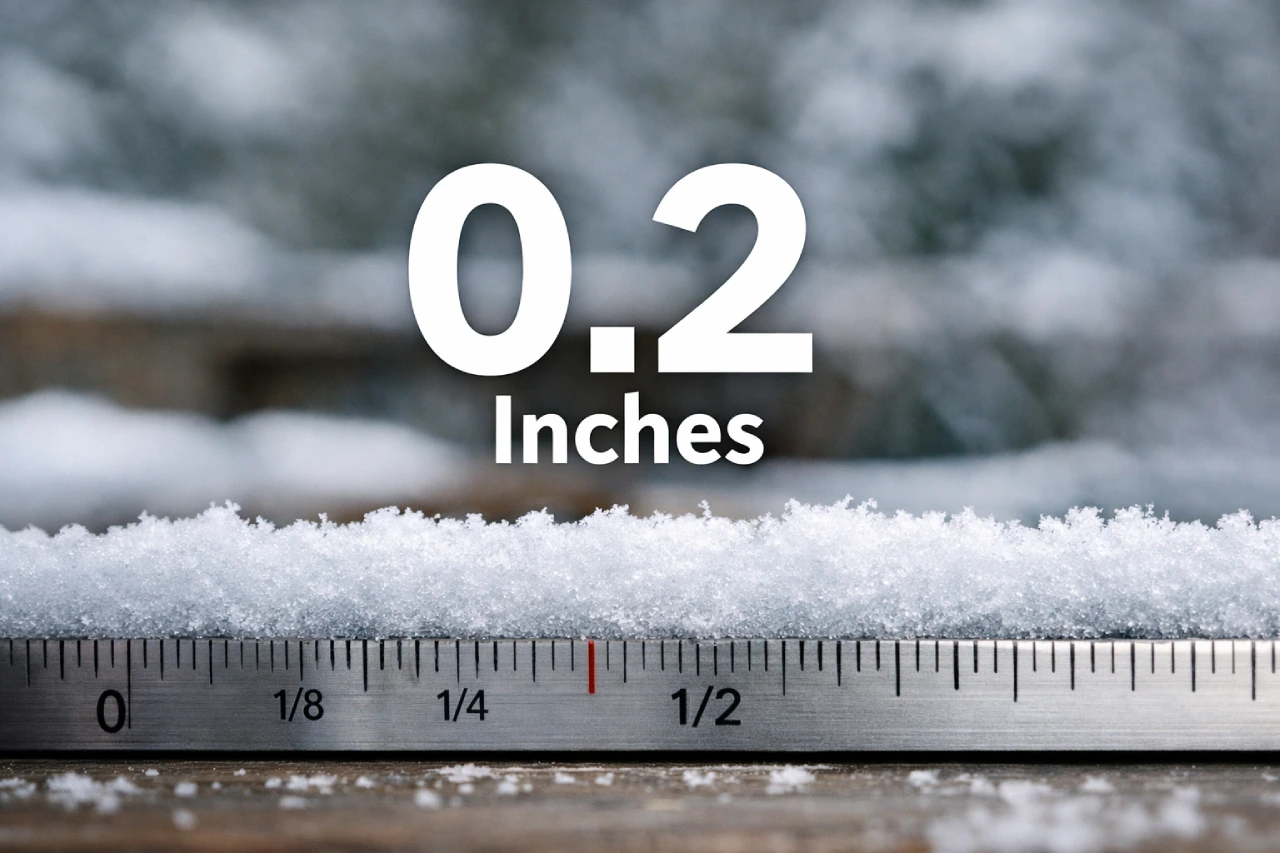
Let’s start with the clear, no-nonsense answer.
0.2 inches is two-tenths of an inch.
That’s it. That’s the direct meaning.
But if you’ve searched for “.2 inches,” you probably already knew that much. What you’re really trying to figure out is what 0.2 inches means in real life. Where does it fall on a ruler? What fraction is it closest to? Is it a common size? And why does it show up so often in specs and measurements?
That’s where this article comes in. We’re going to break down 0.2 inches in a way that feels practical, visual, and easy to remember.
Why People Search for “0.2 Inches”
At first glance, “0.2 inches” looks incomplete. No conversion mentioned. No unit change requested.
But people search this because they see 0.2 inches in places like:
- Digital calipers
- Engineering drawings
- CAD software
- Product dimensions
- Tool specifications
Then they grab a ruler… and get stuck.
Most rulers don’t show decimals. They show fractions. And 0.2 inches doesn’t line up neatly with a standard fraction, which is why people go looking for clarity.
What 0.2 Inches Means in Plain English
Decimal inches divide one inch into tenths and hundredths.
So:
0.2 inches = 2/10 of an inch
That fraction simplifies to:
0.2 inches = 1/5 inch (exact)
This is the mathematically correct fraction.
But here’s the catch.
Why 1/5 Inch Isn’t Useful on a Ruler
Standard rulers are not divided into fifths.
They’re usually marked in:
- 1/2
- 1/4
- 1/8
- 1/16
- Sometimes 1/32
You will never see 1/5 inch printed on a ruler.
So while 1/5 inch is correct on paper, it doesn’t help you measure something physically. That’s why most people really want to know:
What fraction should I actually use for 0.2 inches?
Finding the Closest Fraction to 0.2 Inches
To answer that, let’s compare 0.2 inches to common ruler fractions.
1/8 inch = 0.125
3/16 inch = 0.1875
1/4 inch = 0.25
Now look at the differences.
Difference between 0.2 and 3/16:
0.2 − .1875 = 0.0125
Difference between 0.2 and 1/4:
0.25 − 0.2 = 0.05
That makes it clear.
3/16 inch is much closer to 0.2 inches than 1/4 inch.
So in real-world measuring:
0.2 inches ≈ 3/16 inch
A Simple Ruler Trick That Always Works
Here’s a method you can reuse for almost any decimal inch.
Multiply the decimal by 16.
0.2 × 16 = 3.2
Round to the nearest whole number.
That gives 3/16 inch.
This works because most rulers are marked in sixteenths.
How Accurate Is 3/16 Inch Compared to 0.2 Inches?
Let’s compare the two values directly.
3/16 inch = 0.1875
0.2 inches = 0.2000
Difference = 0.0125 inches
For:
- DIY projects
- Woodworking
- Home repairs
- General construction
That difference is usually acceptable.
For precision machining or tight tolerances, you’d stick with decimals instead of fractions.
Where 0.2 Inches Sits on a Ruler
If you’re holding a ruler and trying to find 0.2 inches, here’s how to visualize it.
- It’s bigger than 1/8 inch
- Slightly bigger than 3/16 inch
- Smaller than 1/4 inch
On a ruler, you’ll land right around the 3/16 mark, just a hair past it.
Once you’ve seen it once, your brain remembers the position.
Is 0.2 Inches a Common Measurement?
Yes, surprisingly common.
You’ll see 0.2 inches used frequently in:
- Engineering specs
- Manufacturing tolerances
- Tool clearances
- Mechanical spacing
- Digital design files
That’s because decimals are easier for software and calculations than fractions.
Designers often think in fractions but write in decimals.
Is 0.2 Inches the Same as 1/4 Inch?
No, and this is an important distinction.
1/4 inch = 0.25 inches
0.2 inches = 0.20 inches
The difference is 0.05 inches, which is noticeable in many applications.
So:
- 0.2 inches is smaller than 1/4 inch
- They are not interchangeable
Is 0.2 Inches the Same as 1/5 Inch?
Yes, mathematically.
0.2 inches = 1/5 inch
But practically:
- You won’t find 1/5 on a ruler
- You’ll measure it as 3/16 inch instead
That’s the difference between exact math and usable measurement.
0.2 Inches Compared to Nearby Measurements
Seeing it in context helps lock it in.
0.125 inches = 1/8
0.1875 inches = 3/16
0.2 inches ≈ 3/16
0.25 inches = 1/4
0.3125 inches = 5/16
This shows clearly where 0.2 inches lives.
Common Mistakes People Make With 0.2 Inches
One common mistake is rounding 0.2 inches up to 1/4 inch. That’s too big.
Another mistake is rounding it down to 1/8 inch, which is too small.
Some people also confuse 0.2 inches with 0.02 inches, which is ten times smaller and a completely different measurement.
Decimals demand attention.
When You Should Use Decimals vs Fractions
Use 0.2 inches when:
- Reading digital calipers
- Working in CAD or design software
- Writing technical specifications
- Doing calculations
Use 3/16 inch when:
- Measuring with a ruler or tape
- Cutting materials
- Drilling holes
- Doing hands-on work
Knowing when to switch saves time and frustration.
Why Small Differences Still Matter
A difference of 0.0125 inches may seem tiny.
But stack several parts together, and the error adds up quickly. That’s how small inaccuracies turn into misalignment, gaps, or fit issues.
Precision isn’t about perfection. It’s about consistency.
Real-World Example
Imagine a slot designed to be 0.2 inches wide.
If you cut it at 1/4 inch, it’s too loose.
If you cut it at 1/8 inch, it won’t fit at all.
But if you cut it at 3/16 inch, you’re very close to the intended size.
That’s why knowing the closest usable fraction matters.
Quick Summary You Can Remember
Let’s lock it in clearly.
- 0.2 inches = 1/5 inch (exact)
- Closest ruler fraction: 3/16 inch
- Smaller than: 1/4 inch
- Bigger than: 1/8 inch
- Best for measuring: 3/16
- Best for math: 0.2
If you remember one thing, remember 3/16 inch.
Final Thoughts
Measurements only feel confusing when numbers on a screen don’t match marks on a ruler.
0.2 inches is a perfect example. It’s clean and simple digitally, but slightly awkward physically. Once you understand where it falls and which fraction to use, the confusion disappears.
And when measuring stops being guesswork, your projects become faster, cleaner, and far more confident.