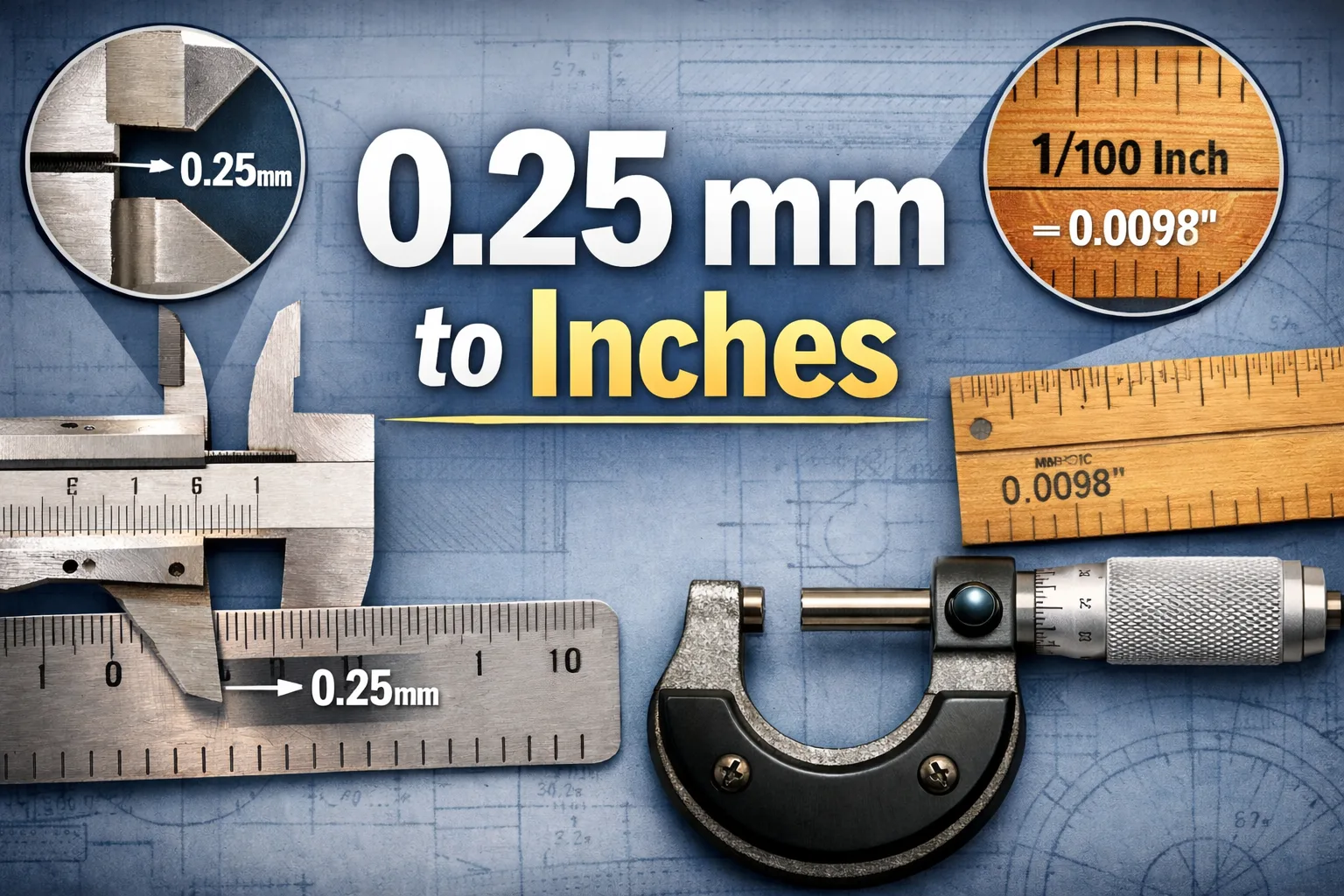
Let’s begin with the direct answer, because that’s usually why people search for this conversion.
0.25 mm = .009842 inches
Rounded for everyday use, you’ll often see it written as 0.0098 inches.
That’s the accurate conversion. But just like many small measurements, the real value of knowing 0.25 mm isn’t just the number itself. It’s understanding where this measurement shows up, how small it truly is, and why converting it to inches matters in real-world situations.
If you’ve ever looked at a specification sheet, tool setting, or design file and paused at 0.25 mm, this article will make everything click.
Why People Search for “0.25mm to Inches”
Millimeters and inches come from two different measurement systems that still coexist.
Millimeters dominate precision work, engineering, electronics, manufacturing, and global standards. Inches remain common in the U.S. for tools, hardware, DIY projects, and everyday measuring.
When these two systems overlap, conversions become unavoidable.
People commonly look up 0.25 mm to inches when working with:
- Engineering and mechanical drawings
- Manufacturing tolerances
- Wire thickness and sheet materials
- 3D printing layer heights
- Jewelry and watch components
- Medical and electronic devices
In these areas, being off by even a fraction of a millimeter can affect fit, performance, or quality.
What 0.25 mm Really Represents
A millimeter is already small. 0.25 mm is very small.
To give you a sense of scale:
- It’s thinner than a sheet of paper
- Roughly a quarter of a millimeter, as the name suggests
- Smaller than the smallest markings on most rulers
- Common in precision tolerances
When converted to inches, the number becomes a tiny decimal, which is why it can feel abstract without context.
The conversion itself is straightforward and consistent.
1 inch = exactly 25.4 millimeters
This value is an international standard and never changes.
So the formula is:
Inches = Millimeters ÷ 25.4
Now apply it.
0.25 ÷ 25.4 = 0.009842519685
Rounded sensibly:
0.25 mm ≈ 0.009842 inches
For most real-world uses, 0.0098 inches is perfectly accurate.
Why 25.4 Is the Only Number You Need to Remember
The number 25.4 is the backbone of every millimeter-to-inch conversion.
It’s not an approximation. It’s exact. That’s why calculators, engineering tables, and CAD software always agree.
Once you remember this number, conversions stop feeling like guesswork and start feeling logical.
How Small Is 0.25 mm Compared to Common Inch Fractions?
Many people think in inch fractions, so comparisons help.
1/64 inch = 0.015625 inches
0.25 mm = 0.009842 inches
That means 0.25 mm is noticeably smaller than 1/64 inch.
This explains why you won’t see it clearly marked on any standard ruler. It’s simply below the resolution of most everyday measuring tools.
Why 0.25 mm Is So Common in Precision Work
Despite its small size, 0.25 mm appears frequently in technical fields.
In 3D printing, it’s a common layer height. In manufacturing, it’s a standard tolerance value. In electronics and medical devices, it represents controlled spacing and thickness.
When parts must fit precisely, numbers like this matter more than most people realize.
Common Mistakes When Converting 0.25 mm to Inches
Small measurements leave little room for error.
One common mistake is rounding too aggressively. Rounding 0.009842 inches down to 0.009 inches loses a noticeable amount of accuracy.
Another mistake is confusing 0.25 mm with 2.5 mm, which is ten times larger.
Some people also assume 0.25 mm is close to 1/32 inch. It’s not. 1/32 inch equals 0.03125 inches, which is more than three times larger.
A Simple Mental Math Shortcut
If you need a quick estimate and don’t need extreme precision, try this trick.
Divide the millimeter value by 25.
0.25 ÷ 25 ≈ 0.01 inches
That’s very close to the exact value of 0.0098 inches. It’s not perfect, but it’s useful for quick checks.
Conversion Table for Better Perspective
Seeing nearby values helps your brain understand scale.
0.1 mm ≈ 0.0039 inches
0.25 mm ≈ 0.0098 inches
0.5 mm ≈ 0.0197 inches
1.0 mm ≈ 0.0394 inches
2.0 mm ≈ 0.0787 inches
Once you notice the pattern, estimating becomes easier.
When Millimeters Are Better Than Inches
For extremely small measurements, millimeters are far easier to work with.
They avoid awkward fractions, scale cleanly, and are the global standard for technical and industrial work. That’s why engineering drawings and international specifications almost always use millimeters.
Inches are great for everyday measuring. Millimeters shine when precision is required.
Real-World Situations Where 0.25 mm Matters
This measurement can make a real difference when:
- Setting 3D printer resolution
- Adjusting machine tolerances
- Designing tightly fitted parts
- Calibrating precision tools
- Working with fine mechanical components
Knowing that 0.25 mm equals about 0.0098 inches helps you make confident decisions instead of guessing.
Why Tiny Differences Add Up
A single 0.25 mm difference may not look dramatic. But stack multiple parts together, and the error compounds quickly.
Ten parts off by 0.25 mm create a 2.5 mm error. In inches, that’s nearly 0.1 inches, which is very noticeable in precision assemblies.
Accuracy isn’t about obsession. It’s about consistency.
Quick Summary You Can Trust
Let’s lock it in clearly.
- 0.25 mm = 0.009842 inches
- For everyday use, 0.0098 inches is accurate
- Based on the exact 25.4 mm per inch standard
- Common in engineering, manufacturing, and precision work
If you remember one thing, remember 0.0098 inches.
Final Thoughts
Some measurements feel insignificant until you understand where they’re used.
0.25 mm may look tiny on paper, but it plays a huge role in precision work across industries. Once you understand how it converts to inches and why that conversion matters, the number stops feeling abstract and starts feeling practical.
Small measurements deserve attention. Especially when precision is the goal.