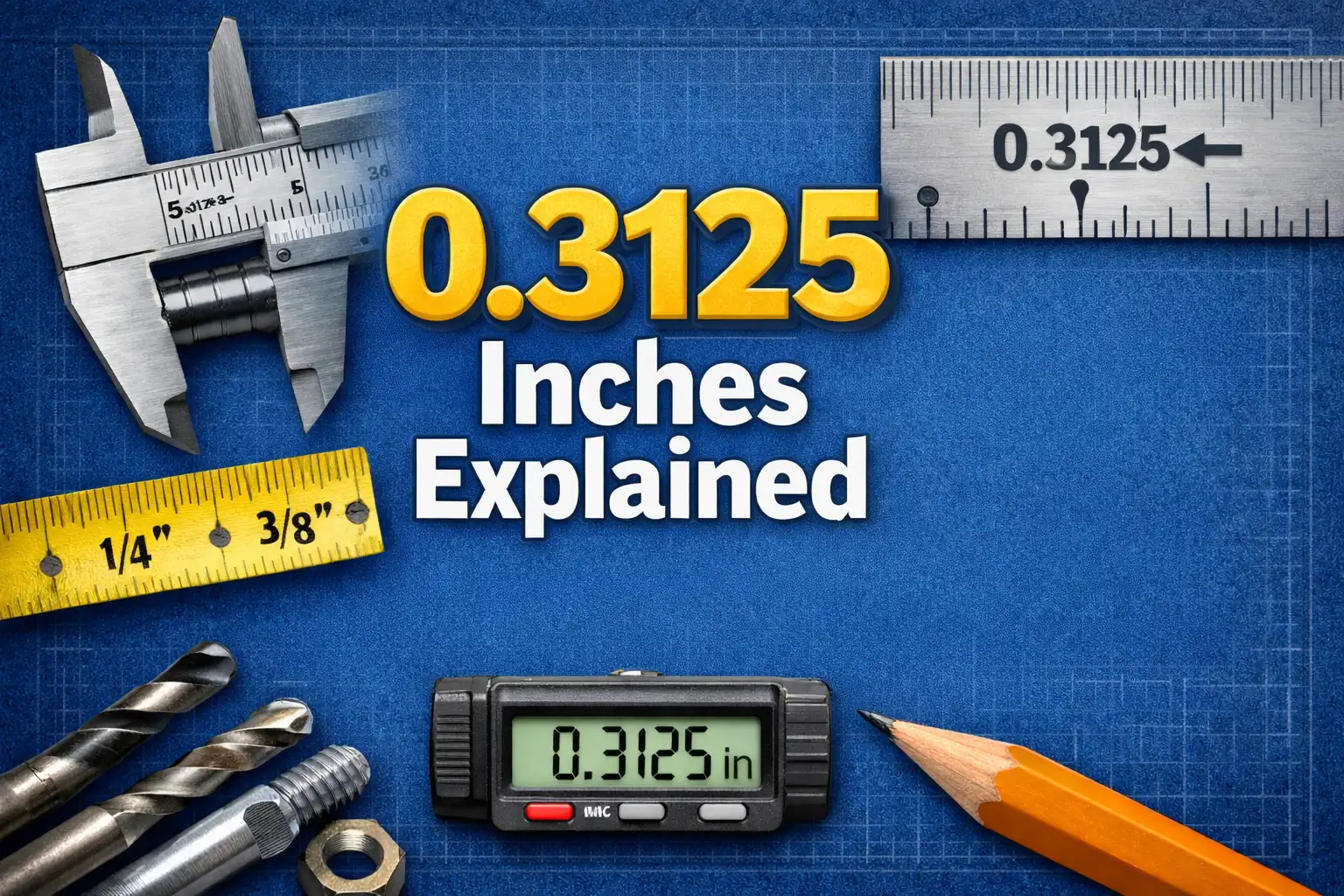
Let’s start with the clear, straight answer, because this one is pleasantly simple.
0.3125 inches is exactly equal to 5/16 inch.
No rounding. No approximation. No “almost.”
It’s a perfect match.
If you’ve ever seen 0.3125 written in a drawing, tool spec, or product description and paused for a second, you’re not alone. This decimal shows up a lot, and once you understand what it represents, it instantly becomes one of the easiest measurements to recognize.
This article will break it down in a friendly, practical way so the number sticks with you for good.
Why People Ask “What Is 0.3125 in Inches?”
At first glance, the question seems confusing because 0.3125 is already in inches. What people are really asking is:
- What fraction is 0.3125 inches?
- Where does 0.3125 land on a ruler?
- Is 0.3125 the same as 5/16 inch?
- How do I measure 0.3125 inches accurately?
These questions usually come up when someone is switching between decimal measurements and fractional tools, which is extremely common in the U.S.
The Simple Math Behind 0.3125 Inches
Let’s break it down step by step.
An inch divided into 16 equal parts gives you sixteenths.
1 ÷ 16 = 0.0625
Now multiply that by 5.
0.0625 × 5 = 0.3125
That’s why:
0.3125 inches = 5/16 inch
Exactly. Cleanly. Permanently.
Decimal Inches vs Fractional Inches
Decimal inches are popular in:
- Engineering drawings
- CAD software
- CNC machines
- Digital calipers
Fractional inches are what you see on:
- Rulers
- Tape measures
- Construction plans
- Hardware labels
Both describe the same lengths. They’re just written differently.
Decimals are easier for math. Fractions are easier for hands-on measuring.
Understanding how they connect saves time and prevents mistakes.
Where Is 0.3125 Inches on a Ruler?
If your ruler is marked in sixteenths, this is easy.
Start at zero.
Count five of the smallest marks.
That fifth mark is 5/16 inch, which equals 0.3125 inches.
If your ruler is marked in eighths, 5/16 sits just past 1/4 inch and before 3/8 inch.
Once you know that, spotting it becomes second nature.
Why 0.3125 Inches Shows Up So Often
This number isn’t random at all.
Because 5/16 inch is such a common size, its decimal form naturally appears in technical documents.
You’ll see it in:
- Drill bit sizes
- Bolt and screw diameters
- Metal rod and shaft specs
- Woodworking measurements
- Mechanical components
Anytime fractions are converted to decimals, 0.3125 pops up.
Comparing 0.3125 Inches to Nearby Measurements
Seeing it in context helps it stick.
1/4 inch = 0.25
9/32 inch = 0.28125
5/16 inch = 0.3125
3/8 inch = .375
So 0.3125 inches sits comfortably between 1/4 and 3/8, slightly closer to 1/4.
Common Mistakes People Make With 0.3125 Inches
One common mistake is assuming 0.3125 inches equals 3/8 inch. It doesn’t. 3/8 inch is 0.375 inches, which is noticeably larger.
Another mistake is confusing 0.3125 with 0.03125. That missing zero makes the measurement ten times smaller.
Some people also assume 0.3125 is an approximation. It’s not. It’s an exact decimal representation of 5/16 inch.
A Quick Recognition Trick
Here’s a handy shortcut.
If a decimal ends in 0.0625, 0.125, 0.1875, 0.25, 0.3125, or 0.375, it almost always comes from a sixteenth-based fraction.
For example:
- 0.0625 = 1/16
- 0.125 = 1/8
- 0.1875 = 3/16
- 0.25 = 1/4
- 0.3125 = 5/16
- 0.375 = 3/8
This pattern makes decimal-to-fraction conversion much faster.
Why Engineers Prefer Writing 0.3125
In technical fields, decimals are easier to calculate with.
Adding, subtracting, and scaling decimals is simpler than juggling fractions. That’s why engineers and machinists often write 0.3125 inches, even though they know it’s 5/16 inch.
It’s not about being fancy. It’s about reducing math errors.
Real-World Situations Where 0.3125 Inches Matters
You’ll encounter this measurement when:
- Choosing drill bits
- Selecting bolts or fasteners
- Measuring shaft diameters
- Reading blueprints
- Setting machining tolerances
Knowing instantly that 0.3125 inches equals 5/16 inch keeps projects moving smoothly.
Why Precision Still Matters Here
Even though 5/16 inch is common, precision still counts.
Using 1/4 inch instead of 5/16 leaves too much slack. Using 3/8 inch creates interference. Small differences matter when parts need to fit correctly.
Exact values prevent costly rework.
Fraction, Decimal, and Metric Together
Here’s a helpful trio to remember:
- Fraction: 5/16 inch
- Decimal: 0.3125 inches
- Metric: 7.9375 mm
All three describe the same length.
Once you see the connection, switching between systems becomes much easier.
Visualizing 0.3125 Inches Without Numbers
If numbers blur together, picture it this way.
- Smaller than your fingertip width
- Bigger than 1/4 inch
- Smaller than 3/8 inch
That’s where 0.3125 inches lives.
Quick Summary You Can Trust
Let’s lock it in clearly.
- 0.3125 inches = 5/16 inch
- Exact conversion, no rounding
- Very common in tools and hardware
- Easy to measure once you recognize it
If you remember one thing, remember 5/16.
Final Thoughts
Some measurements feel awkward. This one doesn’t have to.
0.3125 inches is simply 5/16 inch written in decimal form. Once you recognize that relationship, the number stops feeling mysterious and starts feeling familiar.
And the next time you see 0.3125 on a spec sheet or tool label, you’ll know exactly where it lands on a ruler—no second guessing required.