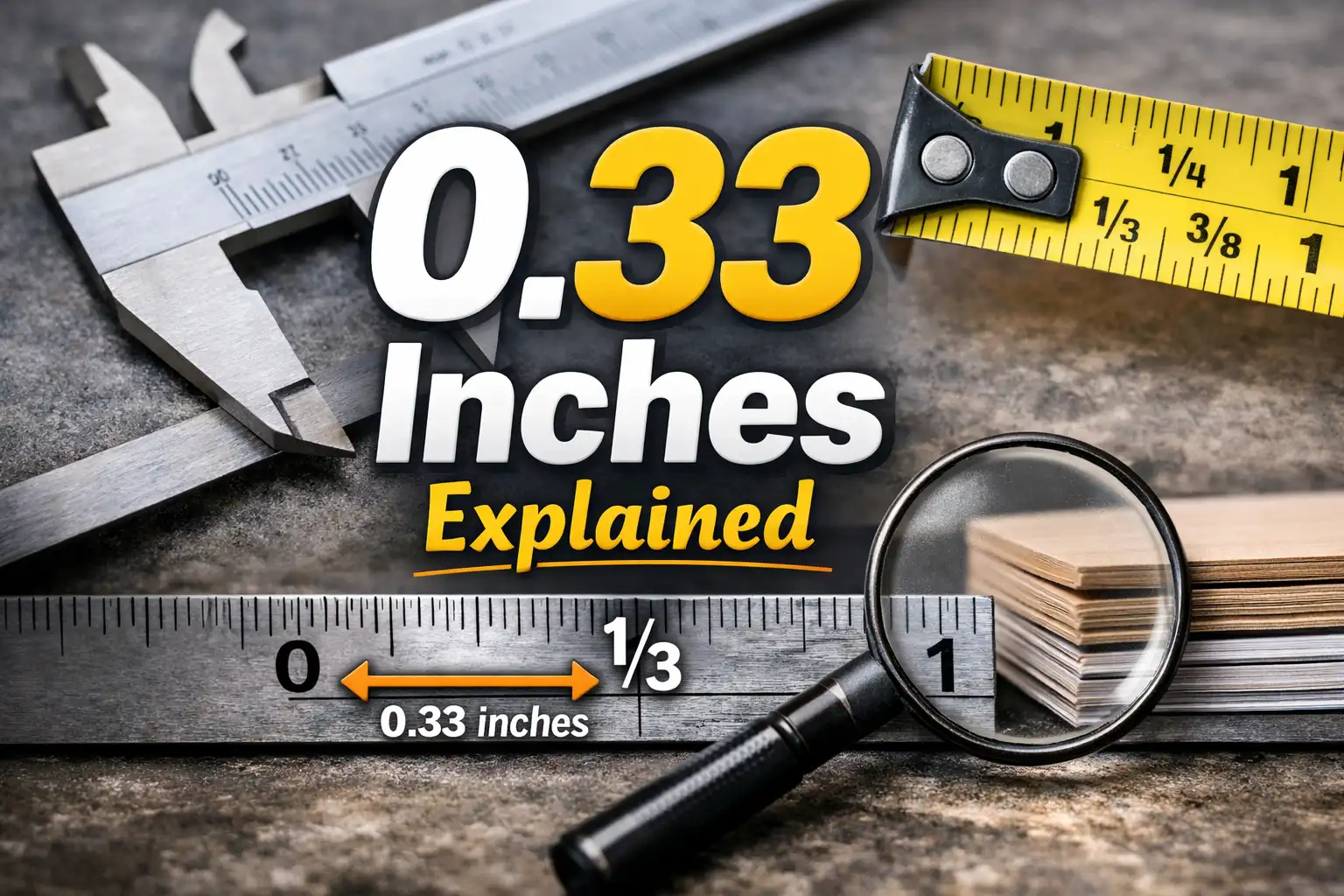
Let’s start with the straight answer, because that’s usually what people want first.
0.33 is already in inches.
But here’s the real question hiding underneath that search:
What fraction of an inch is 0.33, and where does it land on a ruler?
That’s where things get interesting. 0.33 inches does not convert into a clean, exact common fraction, but it does have a very practical real-world equivalent that people use all the time.
By the end of this article, you’ll know:
- The exact mathematical meaning of 0.33 inches
- The closest usable fraction on a ruler
- Why 0.33 shows up so often
- How to measure it confidently without guessing
Why People Search for “0.33 in Inches”
At first glance, the phrase sounds redundant. After all, 0.33 is already an inch measurement.
But in reality, people search this because they’re asking:
- What fraction is 0.33 inches?
- Is 0.33 the same as 1/3 inch?
- Where does 0.33 fall on a tape measure?
- What’s the closest standard ruler mark?
These questions usually come up when someone is switching between decimal measurements and fraction-based tools, which is extremely common in the U.S.
Understanding What 0.33 Inches Actually Means
Decimal inches divide one inch into hundredths.
So when you see 0.33 inches, it literally means:
- Thirty-three hundredths of an inch
Written as a fraction, that is:
0.33 inches = 33/100 inch (exact)
That is the mathematically correct fraction.
But here’s the problem.
Why 33/100 Inch Isn’t Helpful in Real Life
Standard rulers and tape measures are not divided into hundredths.
They’re usually marked in:
- 1/2
- 1/4
- 1/8
- 1/16
- Sometimes 1/32
You will never see 33/100 inch on a ruler.
So while 33/100 is correct on paper, it’s not helpful when you actually need to measure something.
That’s why most people really want the closest common fraction.
Is 0.33 Inches the Same as 1/3 Inch?
This is one of the most common assumptions, and it’s understandable.
Let’s compare them.
1/3 inch = 0.333333…
0.33 inches = 0.330000
They are close, but they are not exactly the same.
Difference:
0.333333 − 0.33 = 0.003333 inches
That difference is tiny, but it does exist. In precision work, it can matter.
So the answer is:
- 0.33 inches is not exactly 1/3 inch
- But it is very close
Finding the Closest Standard Fraction to 0.33 Inches
Now let’s figure out what you should actually use on a ruler.
We’ll compare nearby common fractions.
5/16 inch = 0.3125
11/32 inch = 0.34375
1/3 inch ≈ 0.3333
Now compare differences.
Difference from 5/16:
0.33 − 0.3125 = 0.0175
Difference from 11/32:
0.34375 − 0.33 = 0.01375
Difference from 1/3:
0.3333 − 0.33 ≈ 0.0033
From a pure math standpoint, 1/3 inch is the closest.
But here’s the catch.
Why 1/3 Inch Still Isn’t Ideal on a Ruler
Most standard rulers do not mark thirds.
So even though 1/3 inch is mathematically close, you usually can’t measure it directly unless you’re estimating.
That’s why people often rely on sixteenths or thirty-seconds.
Best Practical Fraction to Use on a Ruler
Let’s convert .33 inches using sixteenths.
Multiply by 16:
0.33 × 16 = 5.28
That rounds to 5/16 inch.
Now try thirty-seconds:
0.33 × 32 = 10.56
That rounds to 11/32 inch.
So here’s the practical breakdown:
- Exact fraction: 33/100 inch
- Closest conceptual fraction: ~1/3 inch
- Closest ruler fraction (16ths): 5/16 inch
- Closer ruler fraction (32nds): 11/32 inch
If your ruler has 32nds, use 11/32 inch.
If it only has 16ths, use 5/16 inch.
Visualizing 0.33 Inches on a Ruler
If numbers blur together, try this mental picture.
- 1/4 inch is clearly smaller
- 3/8 inch is clearly bigger
- 0.33 inches sits closer to 1/3 than either
On a ruler, it’s:
- Slightly past 5/16
- Slightly before 11/32
- Roughly one-third of the way across an inch
Once you see that relationship, it becomes much easier to eyeball.
Why 0.33 Inches Appears So Often
This number shows up a lot because it’s a convenient decimal approximation of one-third.
You’ll see it in:
- Design software
- Engineering drawings
- Product specs
- Digital measurements
- Online calculators
Decimals are easier for software. Fractions are easier for hands.
That’s why this conversion question keeps coming up.
Common Mistakes People Make With 0.33 Inches
One mistake is assuming 0.33 inches equals 3/8 inch. It doesn’t. 3/8 inch is 0.375 inches, which is noticeably larger.
Another mistake is assuming 0.33 is exactly 1/3 inch. It’s close, but not exact.
Some people also confuse 0.33 inches with 0.033 inches, which is ten times smaller and completely different.
Decimals require attention.
A Simple Method You Can Reuse Anytime
Here’s a reliable approach for any decimal inch.
- Multiply by 16 or 32
- Round to the nearest whole number
- Use that fraction on your ruler
It won’t always be perfect, but it will be practical and repeatable.
Real-World Situations Where 0.33 Inches Comes Up
You’ll encounter this measurement when:
- Reading digital calipers
- Following CAD designs
- Working from online plans
- Measuring non-critical dimensions
- Approximating thirds in physical layouts
Knowing how to convert it prevents trial-and-error measuring.
Quick Reference Summary
Let’s lock it in clearly.
- 0.33 inches = 33/100 inch (exact)
- Very close to: 1/3 inch
- Closest ruler fraction (32nds): 11/32 inch
- Closest ruler fraction (16ths): 5/16 inch
If you need precision, use decimals.
If you need practicality, use the nearest fraction your ruler supports.
Final Thoughts
Measurements don’t get confusing because of math. They get confusing because tools and systems don’t always line up.
0.33 inches is a perfect example. It’s simple on screen but awkward on a ruler. Once you understand the difference between exact and usable, the confusion disappears.
And when you stop guessing measurements, your projects get cleaner, faster, and far less frustrating.