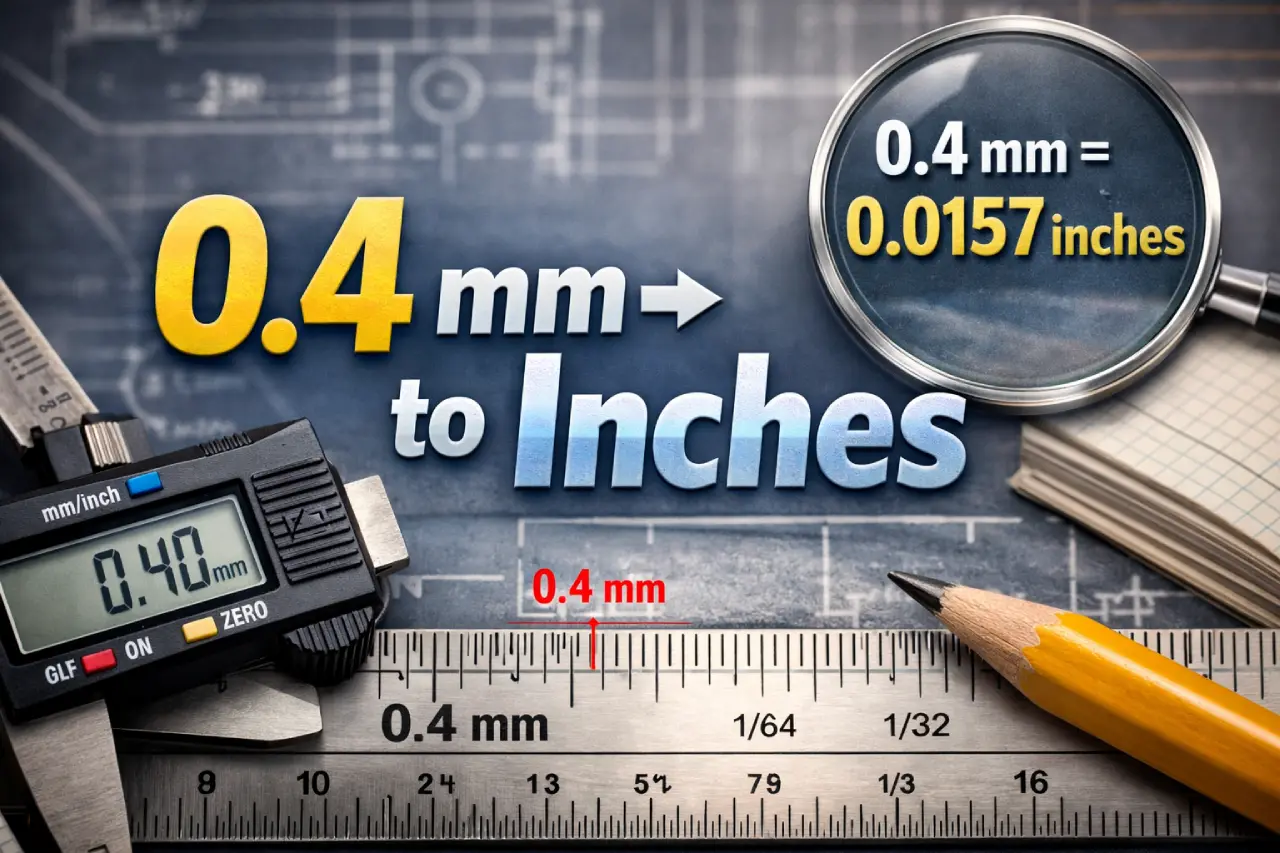
Let’s start with the answer, nice and clear.
0.4 millimeters equals approximately .0157 inches.
That’s the exact conversion most people are looking for. Just over one-hundredth of an inch. Very small, yes—but far from unimportant.
The 0.4 mm to inches conversion shows up constantly in real life, especially in areas where precision matters more than size. Think engineering, electronics, jewelry, machining, medical tools, watchmaking, and even 3D printing. When measurements get this small, guessing is not an option.
Let’s break this down in a way that actually makes sense and sticks with you.
What Does 0.4 mm Really Mean?
Before converting anything, it helps to understand what 0.4 millimeters actually represents.
Understanding 0.4 Millimeters
A millimeter is already a small unit. So 0.4 mm is tiny.
To put it in perspective:
- 1 mm = about the thickness of a credit card
- 0.4 mm = less than half of that
- It’s roughly the thickness of a few sheets of paper stacked together
This is not a measurement you eyeball. It’s something you measure with calipers, micrometers, or precision rulers.
That’s why accurate conversion matters so much.
The Exact Conversion: 0.4 mm to Inches
Now let’s convert it properly using the official standard.
The fixed rule is:
1 inch = 25.4 millimeters
To convert millimeters to inches, you divide by 25.4.
The Math
0.4 ÷ 25.4 = 0.015748 inches
Rounded to four decimal places, this becomes:
0.0157 inches
So whenever you see 0.4 mm in inches, this is the correct, reliable value.
Why This Small Conversion Matters More Than You Think
It’s easy to dismiss small numbers. But in many fields, 0.4 mm can be the difference between success and failure.
Common Uses of 0.4 mm
- Electronics components and spacing
- Watch and jewelry parts
- Sheet metal thickness
- Medical instruments
- Precision machining tolerances
- 3D printer nozzle and layer settings
- Mechanical clearances
In these situations, even a difference of .01 inches can cause serious problems.
Visualizing 0.4 mm in Inches
Let’s make this easier to picture.
On a metric ruler:
- 1 mm is already small
- 0.4 mm is less than half that distance
On an inch ruler:
- One inch is divided into fractions like 1/16 or 1/32
- 0.0157 inches is slightly larger than 1/64 inch
- It’s far smaller than 1/32 inch
This explains why inches can feel awkward for tiny measurements—fractions just don’t scale well at this size.
Is 0.4 mm the Same as 0.016 Inches?
Close, but not exact.
- 0.016 inches is slightly larger
- 0.0157 inches is the accurate conversion
- The difference seems tiny, but precision work notices it
For rough comparisons, rounding might be acceptable. For technical work, it’s not.
Why Millimeters Are Preferred for Small Measurements
This conversion highlights a big truth.
Millimeters are simply better for small measurements.
Why mm Makes More Sense at Tiny Scales
- No awkward fractions
- Easy decimal math
- Clear precision
- Widely used in science and engineering
Saying “0.4 mm” is much clearer than saying “0.0157 inches,” especially when accuracy matters.
Quick Comparison for Better Context
Here’s how 0.4 mm compares to nearby measurements:
- 0.2 mm ≈ 0.0079 inches
- 0.4 mm ≈ 0.0157 inches
- 0.5 mm ≈ 0.0197 inches
- 1 mm ≈ 0.0394 inches
Seeing it this way helps you understand just how small this measurement really is.
How to Convert mm to Inches Yourself
You don’t need a calculator every time if you remember one number.
25.4
Simple Formula
Millimeters ÷ 25.4 = Inches
Example
0.4 ÷ 25.4 = 0.0157 inches
Once you’ve done this a few times, it becomes automatic.
Rounding: When It’s Safe and When It’s Not
Rounding is the most common source of errors.
When Rounding Is Risky
- Engineering drawings
- CNC machining
- Medical devices
- Electronics manufacturing
- Tight mechanical fits
In these cases, 0.0157 inches must stay 0.0157 inches.
When Rounding Is Usually Fine
- Informal comparisons
- Visual estimates
- Educational examples
The rule is simple: know the exact value first, then decide.
Why Inches Feel Clumsy at This Scale
Inches are great for measuring people, furniture, rooms, and tools. But when you get into tiny measurements, they struggle.
That’s why:
- Engineers use millimeters
- Scientists use metric units
- Precision industries avoid fractions
Trying to express 0.4 mm in inches shows exactly why.
A Quick Note on Measurement Standards
This conversion isn’t a guess.
In 1959, an international agreement defined:
- 1 inch as exactly 25.4 millimeters
That’s why conversions like 0.4 mm to inches are consistent and reliable worldwide.
Real-Life Situations Where This Conversion Is Useful
You’ll need this conversion when:
- Reading international technical specs
- Designing small mechanical parts
- Working with electronics or micro-components
- Comparing metric and imperial drawings
- Ordering precision materials
Knowing the exact value saves time and prevents costly mistakes.
Final Answer (Clear and Simple)
Let’s lock it in one last time.
0.4 millimeters equals approximately 0.0157 inches.
It’s tiny, precise, and surprisingly important. And now, it’s a number you won’t have to look up again.
Once you understand this conversion, working with very small measurements feels far less intimidating—and a lot more confident.