Let’s start with the clear, straight answer before diving deeper.
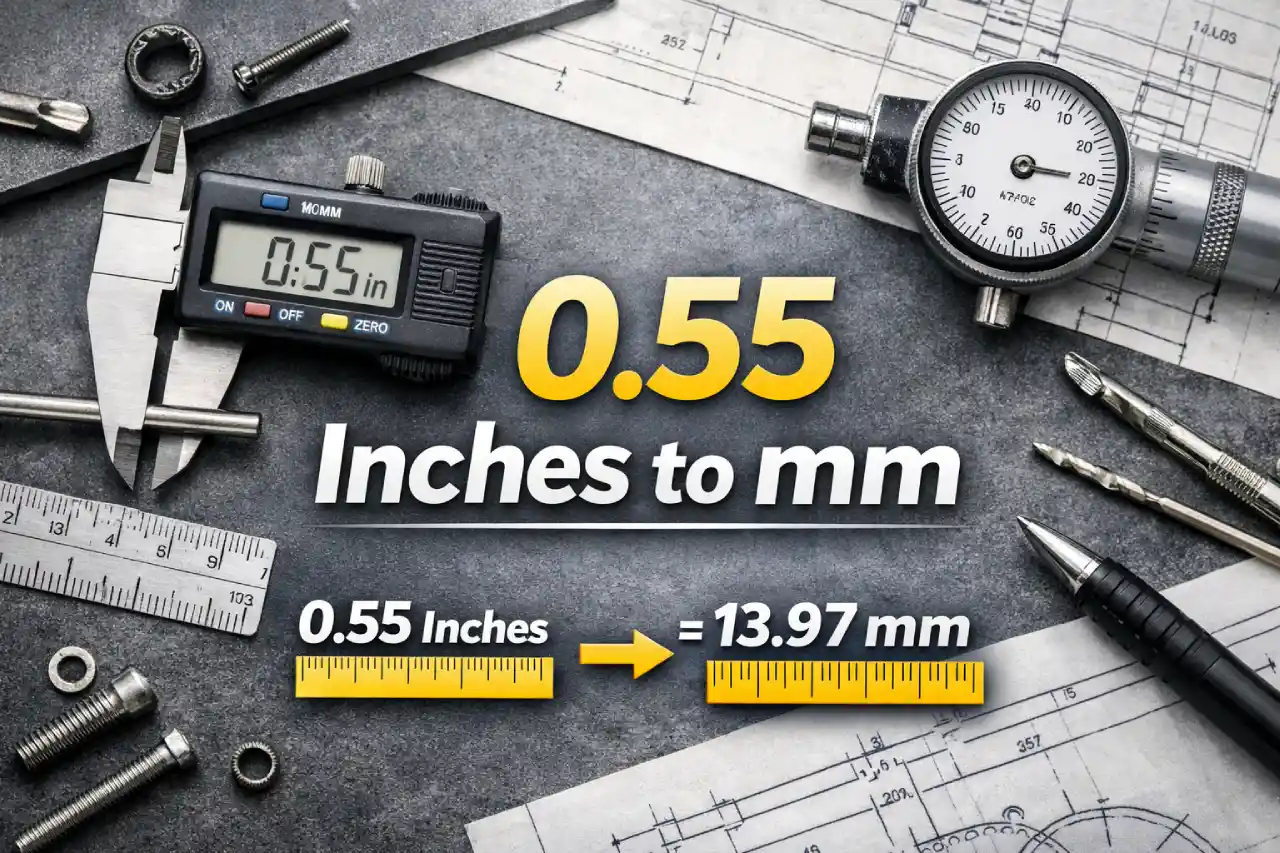
0.55 inches = 13.97 millimeters
This value is exactly calculated using the standard inch-to-millimeter conversion. No guessing, no shortcuts.
But if you searched for “0.55 inches to mm,” you’re probably not just looking for the number 13.97. You’re trying to understand what this measurement really means, how big it is in real life, whether it’s close to a round metric size, and why this conversion shows up so often in tools, specs, and designs.
That’s exactly what this guide covers—step by step, in simple, human language.
Why People Search for “0.55 Inches to mm”
Inches and millimeters live in two different measurement worlds, but they collide constantly.
Inches are still widely used in the U.S. for construction, hardware, woodworking, and everyday measuring. Millimeters dominate engineering, manufacturing, electronics, machining, and international standards.
So when a design, part, or tool lists 0.55 inches, many people immediately need to convert it into millimeters to:
- Match metric components
- Read international specifications
- Program CNC machines
- Check tolerances
- Compare part sizes accurately
That’s why this conversion is so common.
The Exact Formula Used for the Conversion
Every inch-to-millimeter conversion uses the same fixed rule.
1 inch = exactly 25.4 millimeters
This number is internationally standardized and never changes.
So the formula is simple:
Millimeters = Inches × 25.4
Now apply it.
0.55 × 25.4 = 13.97
That gives us the exact result:
0.55 inches = 13.97 mm
Why This Value Is Exact (Not Rounded)
Some conversions result in long, repeating decimals. This one doesn’t.
That’s because:
- 0.55 inches = 55/100 inch
- 25.4 mm per inch is exact
When you multiply them, the math lands cleanly on 13.97 mm.
No rounding is required unless you choose to round for convenience.
Visualizing 13.97 mm in Real Life
If millimeters aren’t your everyday language, here’s how to picture 13.97 mm.
It is:
- Just under 14 mm
- Slightly more than half an inch
- About the width of a standard adult finger
- Larger than most screws, smaller than many bolts
It’s close to 14 mm, but not the same—and that difference can matter.
Is 13.97 mm Basically the Same as 14 mm?
This is one of the most common follow-up questions.
The difference is:
- 14.00 mm − 13.97 mm = 0.03 mm
- That’s about .0012 inches
For rough DIY work, that difference is usually insignificant.
For machining, precision fitting, or stacked components, it can matter.
So:
- 13.97 mm is very close to 14 mm
- But it is not identical
Precision depends on context.
Understanding 0.55 Inches on Its Own
Before converting, it helps to understand the inch value itself.
As a fraction:
- 0.55 inches = 11/20 inch (exact)
That’s mathematically correct, but you’ll never see 11/20 marked on a ruler. That’s why 0.55 inches usually appears in digital readouts, CAD files, or specifications rather than on tape measures.
Where 0.55 Inches Sits on a Ruler
If you’re trying to visualize 0.55 inches on a ruler, here’s how to picture it.
Common fractions nearby are:
- 1/2 inch = 0.50
- 9/16 inch = 0.5625
- 5/8 inch = 0.625
.55 inches falls:
- Above 1/2 inch
- Slightly below 9/16 inch
So on a ruler marked in sixteenths, you’d measure just under 9/16 inch.
Why 0.55 Inches Appears So Often in Specs
Decimal values like 0.55 show up frequently because:
- Software prefers decimals
- Calculations are easier
- Scaling is faster
- Fractions can introduce rounding issues
Engineers and designers often think visually in fractions but document measurements in decimals.
That’s why 0.55 inches shows up so often in technical drawings and part descriptions.
Common Mistakes When Converting 0.55 Inches to mm
Even simple conversions can go wrong.
One common mistake is rounding 13.97 mm up to 14 mm without checking tolerance limits.
Another mistake is confusing 0.55 inches with .055 inches, which is ten times smaller.
Some people also mistakenly multiply by 2.54 instead of 25.4, forgetting that 2.54 converts inches to centimeters, not millimeters.
Small decimal slips can cause real-world fit problems.
Fraction, Decimal, and Metric Together
Here’s a clean way to remember this measurement across systems.
- Fraction: 11/20 inch
- Decimal: 0.55 inches
- Metric: 13.97 mm
All three describe the same physical length.
Once you see that relationship, conversions stop feeling random.
A Quick Mental Math Shortcut
If you need a fast estimate and don’t need perfect precision, here’s a handy trick.
Remember:
- 1 inch ≈ 25 mm
So:
0.55 × 25 ≈ 13.75 mm
That gets you very close quickly. For exact work, always use 25.4.
Where This Measurement Is Commonly Used
You’ll encounter 0.55 inches (13.97 mm) in:
- Mechanical spacing and clearances
- Tool and component thicknesses
- Industrial design specs
- Hardware and fastener dimensions
- Machined parts
Knowing the metric equivalent helps when matching imperial designs with metric components.
Comparison Table for Context
Seeing nearby values helps lock the scale into your brain.
0.50 inches = 12.7 mm
0.55 inches = 13.97 mm
0.60 inches = 15.24 mm
0.625 inches = 15.875 mm
This shows clearly where 0.55 inches sits in the metric world.
Why Precision Matters More Than It Seems
A difference of 0.03 mm might sound tiny.
But in precision assemblies, that can lead to:
- Poor fit
- Misalignment
- Increased wear
- Assembly difficulty
Exact values prevent small problems from becoming expensive ones.
When to Stick With Millimeters Instead of Inches
For measurements under an inch, millimeters are often easier to work with.
They avoid awkward decimals, scale cleanly, and are the global standard for technical work. That’s why engineering drawings and international manufacturing usually default to millimeters.
Inches are great for everyday measuring. Millimeters shine when precision matters.
Real-World Example
Imagine a spacer designed to be 0.55 inches thick.
If you substitute 14 mm, you’ve added 0.03 mm. One spacer may be fine, but stack several together and the error grows.
That’s how “almost the same” becomes a problem.
Quick Summary You Can Trust
Let’s lock it in clearly.
- 0.55 inches = 13.97 mm
- Exact conversion
- Based on the 25.4 mm per inch standard
- Very close to, but not equal to, 14 mm
If you remember one number, remember 13.97 mm.
Final Thoughts
Some conversions look simple until you try to use them in real life.
0.55 inches feels like a clean decimal, but precision lives in the details. Once you understand how it converts to 13.97 mm and why that exact value matters, the confusion disappears.
And when measurements stop being guesswork, everything you build fits better the first time.