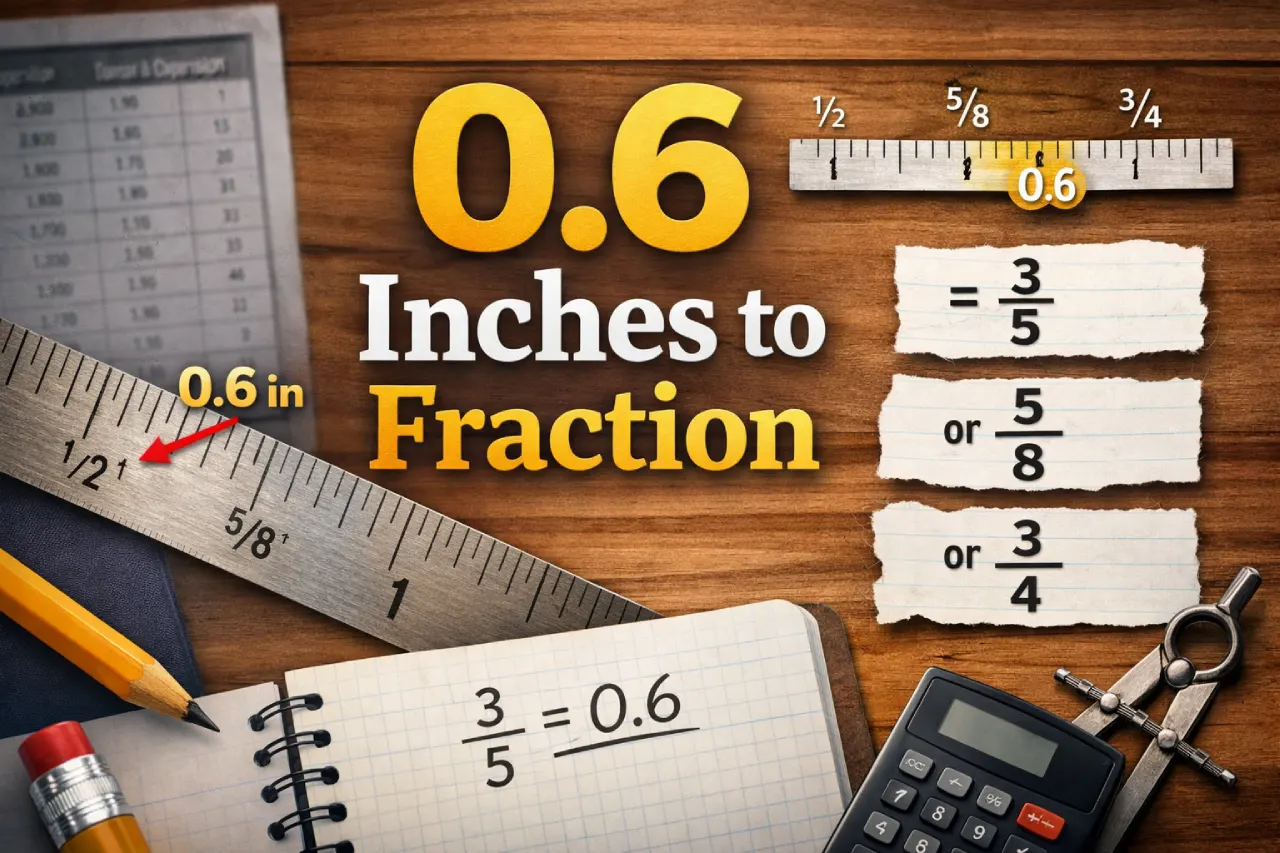
Let’s start with the clean, honest answer—because this one has two answers, and both matter.
0.6 inches = 3/5 inch (exact)
That’s the mathematically correct fraction.
But if you’re here because you’re holding a ruler (or a tape measure) and wondering where 0.6 inches actually lands, then 3/5 inch won’t help you much. Standard rulers don’t show fifths.
So the real question becomes:
What fraction should I actually use on a ruler for .6 inches?
This article breaks it all down—exact value, closest practical fraction, how to find it fast, and how to avoid the most common measuring mistakes.
Why People Search for “0.6 Inches to Fraction”
You’ll see 0.6 inches pop up in plenty of places:
- Digital calipers
- CAD drawings
- Engineering specs
- Product dimensions
- Online calculators
Then you pick up a ruler and… there’s no 3/5 anywhere.
Rulers speak in halves, quarters, eighths, and sixteenths. Decimals speak a different language. This article is your translator.
What 0.6 Inches Means in Plain English
Decimal inches divide one inch into tenths.
So:
0.6 inches = six-tenths of an inch
As a fraction:
0.6 = 6/10 = 3/5 inch (exact)
This is clean, simple math. And it’s perfectly correct.
But it’s not very useful for hands-on measuring.
Why 3/5 Inch Isn’t Helpful on a Ruler
Take a look at any standard ruler.
You’ll see marks for:
- 1/2
- 1/4
- 1/8
- 1/16
- Sometimes 1/32
You will never see fifths.
So while 3/5 inch is right on paper, it doesn’t help you mark or cut anything accurately. That’s why most people really want to know:
What standard fraction is closest to 0.6 inches?
Finding the Closest Fraction to 0.6 Inches
Let’s compare .6 inches to common ruler fractions.
Here are the usual suspects:
9/16 inch = 0.5625
5/8 inch = 0.625
3/4 inch = 0.75
Now let’s check the differences.
Difference between .6 and 9/16:
0.6 − .5625 = .0375
Difference between 0.6 and 5/8:
0.625 − 0.6 = 0.025
Difference between .6 and 3/4:
0.75 − 0.6 = 0.15
That makes the answer clear.
5/8 inch is the closest standard ruler fraction to 0.6 inches.
So for practical measuring:
0.6 inches ≈ 5/8 inch
The Simple Ruler Trick That Makes This Easy
Here’s a fast method you can reuse anytime.
Most rulers are marked in sixteenths. So:
Multiply the decimal by 16.
0.6 × 16 = 9.6
Round to the nearest whole number.
That gives 10/16, which simplifies to:
5/8 inch
Once you know this trick, decimal-to-fraction measuring gets much easier.
How Accurate Is 5/8 Inch Compared to 0.6 Inches?
Let’s compare them directly.
0.6 inches = 0.6000
5/8 inch = 0.6250
Difference = 0.025 inches
For:
- DIY projects
- Woodworking
- Home repairs
- General layout work
That difference is usually acceptable.
For:
- Machining
- Precision fitting
- Tight tolerances
You’ll want to stick with decimals instead of fractions.
Where 0.6 Inches Sits on a Ruler
If you’re holding a ruler and trying to visualize 0.6 inches, here’s how to picture it.
- It’s larger than 9/16 inch
- Slightly smaller than 5/8 inch
- Well below 3/4 inch
On a ruler marked in sixteenths, it’s just a bit before the 5/8 mark.
Once you’ve seen it once, your eye learns it quickly.
Is 0.6 Inches the Same as 1/2 Inch?
No—and this is a very common mistake.
1/2 inch = 0.5
0.6 inches = 0.6
Difference = 0.1 inches
That’s a big jump in most projects.
So:
- 0.6 inches is noticeably larger than 1/2 inch
- They are not interchangeable
Is 0.6 Inches the Same as 5/8 Inch?
Not exactly, but they’re close.
5/8 inch = 0.625
0.6 inches = 0.600
Difference = 0.025 inches
So:
- 0.6 inches is slightly smaller than 5/8 inch
- Close enough for rough work, not identical for precision work
Why 0.6 Inches Shows Up So Often
Decimal values like 0.6 are popular because:
- Software prefers decimals
- Calculations are quicker
- Scaling is easier
- Fractions can introduce rounding confusion
Designers often think visually in fractions but document measurements in decimals. That’s why 0.6 inches appears frequently in digital designs.
Common Mistakes People Make With 0.6 Inches
One common mistake is rounding 0.6 inches down to 1/2 inch. That’s too small.
Another is rounding it up to 3/4 inch, which is far too large.
Some people also confuse 0.6 inches with 0.06 inches, which is ten times smaller and a completely different measurement.
Decimals reward careful reading.
0.6 Inches Compared to Nearby Measurements
Seeing it in context helps lock it into memory.
0.5625 inches = 9/16
0.6 inches ≈ 5/8
0.625 inches = 5/8
0.75 inches = 3/4
This shows clearly where 0.6 inches lives.
When to Use Decimals vs Fractions
Use 0.6 inches when:
- Reading digital calipers
- Working in CAD or design software
- Writing specifications
- Doing calculations
Use 5/8 inch when:
- Measuring with a ruler
- Cutting materials
- Drilling holes
- Doing hands-on work
Switching between the two is normal—and smart.
Real-World Example
Imagine a panel designed to be 0.6 inches thick.
If you cut it at 1/2 inch, it may be too thin.
If you cut it at 3/4 inch, it will be too thick.
But if you cut it at 5/8 inch, you’re very close to the intended size.
That’s why knowing the closest usable fraction matters.
Why Small Differences Add Up
A difference of 0.025 inches might not seem dramatic.
But stack several parts together, and those small differences accumulate quickly. That’s how “close enough” turns into fit problems.
Precision isn’t about obsession—it’s about consistency.
Quick Summary You Can Remember
Let’s lock it in clearly.
- 0.6 inches = 3/5 inch (exact)
- Closest ruler fraction: 5/8 inch
- Larger than: 9/16 inch
- Smaller than: 5/8 inch (slightly)
- Best for measuring: 5/8
- Best for math: .6
If you remember one thing, remember 5/8 inch.
Final Thoughts
Decimal-to-fraction conversions only feel tricky until you know how rulers actually work.
0.6 inches is a great example. It’s simple on a screen, a little awkward on a ruler, but once you know which fraction to use—and why—it stops being confusing.
And when measuring stops being guesswork, your projects turn out cleaner, faster, and far more satisfying.