If you’ve ever picked up a drill bit, Allen key, or small fastener labeled 5/32 inch, you’ve probably wondered what that translates to in millimeters—especially if your tools are metric.
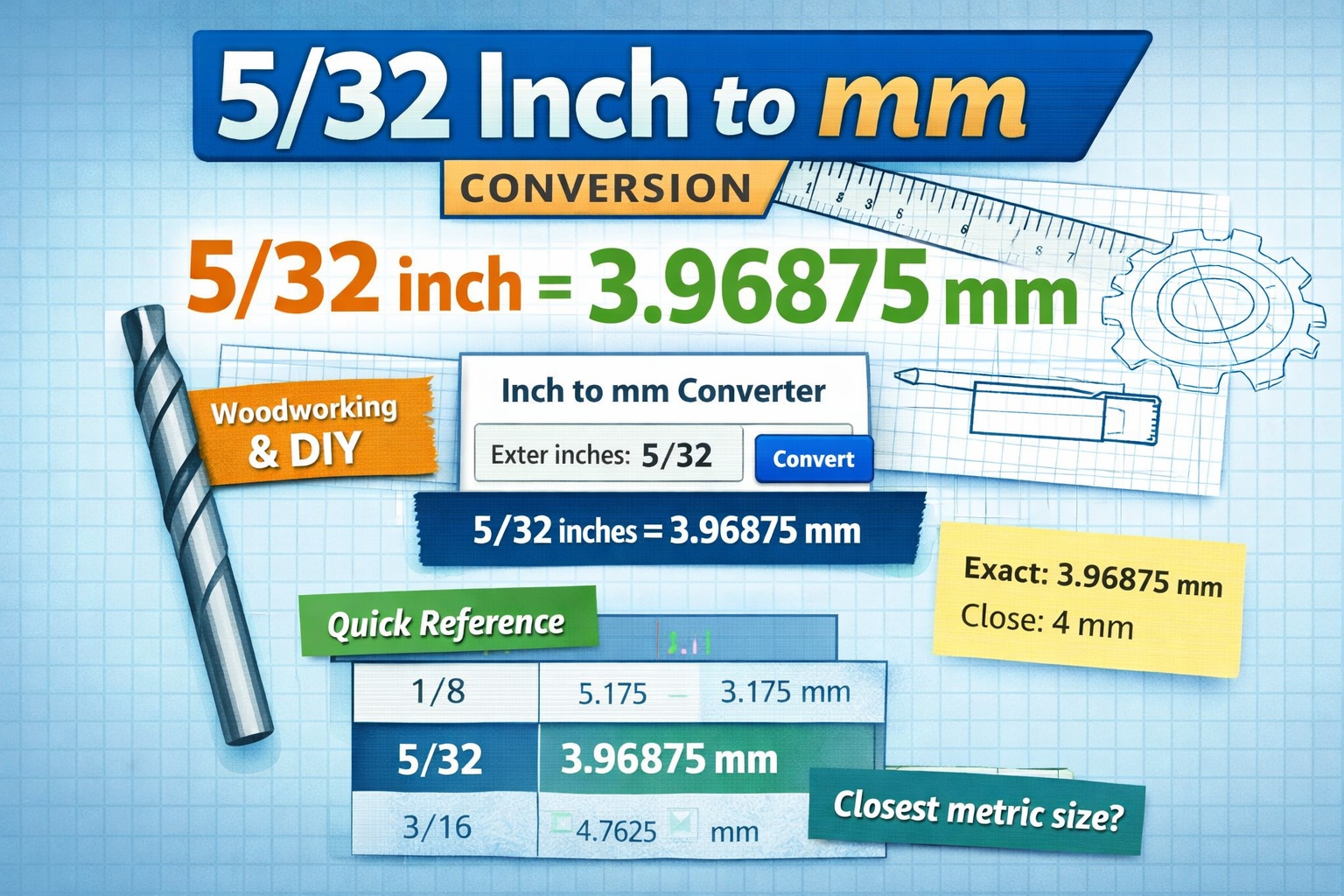
Here’s the direct answer: 5/32 inch equals 3.96875 mm.
But instead of just giving you the number and moving on, let’s look at how this measurement actually behaves in real-world situations—because that’s where most people get confused.
Why 5/32 Inch Feels “Awkward” in Metric
Unlike larger fractions like 1/2 inch or 1/4 inch, 5/32 inch doesn’t convert neatly into a clean metric number. You end up with 3.96875 mm, which sits awkwardly between common metric sizes.
This is exactly why people often hesitate when choosing tools. You won’t usually find a drill bit labeled 3.96875 mm. Instead, you’ll see 3.9 mm or 4 mm, and that’s where decision-making comes in.
Breaking It Down Without Overthinking
Instead of going step-by-step like a math class, here’s the simplest way to understand it:
- 5/32 inch = just under 4 mm
- Exact value = 3.96875 mm
- Practical takeaway = “very close to 4 mm, but slightly smaller”
That small difference is what determines whether something fits snugly or loosely.
Choosing the Right Metric Equivalent (Real-World Thinking)
This is where most guides stop—but this is actually the most useful part.
Let’s say you don’t have a 5/32-inch tool and need to substitute it with a metric one. Here’s how to think about it:
If you choose 4 mm, you’re going slightly larger than the original size. This works fine in situations where a looser fit is acceptable, like general drilling or non-precision tasks.
If you need a tighter fit, especially in mechanical or threaded applications, using something closer to 3.9 mm (if available) will give better accuracy.
In short, 5/32 inch lives in that “decision zone” where your choice depends on tolerance, not just math.
Where You’ll Actually Encounter 5/32 Inch
This measurement shows up more often than people expect, especially in smaller-scale work.
In woodworking, 5/32-inch drill bits are commonly used for pilot holes before inserting screws. It helps prevent splitting while still allowing a firm hold.
In hardware and assembly, you’ll often find 5/32-inch Allen keys used in furniture, bicycles, and small mechanical parts. If you’ve ever assembled flat-pack furniture, chances are you’ve used one.
In hobby work or electronics, this size appears in small components where precision matters but space is limited.
Precision vs Practical Use
Let’s talk honestly—do you always need 3.96875 mm? Not really.
The level of precision you need depends entirely on the task.
If you’re doing machining, engineering, or anything where tolerances are tight, then yes, you should stick as close as possible to the exact value.
But for most DIY, home improvement, or woodworking tasks, rounding to 3.97 mm or even 4 mm is usually fine.
The key is understanding the consequence:
- Slightly bigger = looser fit
- Slightly smaller = tighter fit
A Different Way to Remember This Conversion
Instead of memorizing the full decimal, here’s a more practical way to remember it:
Think of 5/32 inch as:
- Halfway between 1/8 inch (3.175 mm) and 3/16 inch (4.7625 mm)
- Closer to 4 mm than 3 mm
That mental reference is often more useful than remembering five decimal places.
Comparison With Nearby Sizes
To really understand 5/32 inch, it helps to see it in context:
| Size (inch) | Millimeters | How It Feels |
|---|---|---|
| 1/8 | 3.175 mm | Noticeably smaller |
| 5/32 | 3.96875 mm | Just under 4 mm |
| 3/16 | 4.7625 mm | Clearly larger |
This makes it easier to estimate even without exact calculations.
Common Situations Where People Get It Wrong
One of the most common mistakes is assuming 5/32 inch equals exactly 4 mm. It’s close—but not equal. That tiny difference can matter when working with tight fittings.
Another issue is forcing a metric substitute without considering tolerance. Just because something “fits” doesn’t mean it’s the right fit.
Also, many people ignore the purpose of the measurement. A pilot hole, for example, doesn’t require the same precision as a bolt fitting.
Inch to mm Converter
Inch to mm Converter
A Practical Example You’ll Recognize
Imagine you’re drilling a pilot hole for a screw that recommends a 5/32-inch bit. You only have metric bits available.
You check your set and see:
- 3.5 mm
- 4 mm
Now you understand the choice:
- 3.5 mm → tighter, risk of splitting
- 4 mm → slightly loose, easier insertion
Because 5/32 inch equals 3.96875 mm, 4 mm is usually the better practical choice in this scenario.
Quick Estimation Trick (No Calculator Needed)
If you ever need a rough estimate, here’s a simple trick.
Multiply the inch value by 25 to get close, then add a tiny bit more. For 0.15625 inches, that gives you just under 4 mm, which is accurate enough for quick decisions.
Final Thoughts
The conversion 5/32 inch = 3.96875 mm is simple on paper, but its real value comes from understanding how to use it. This is one of those measurements where context matters more than the number itself.
Instead of focusing only on the exact decimal, think in terms of fit, tolerance, and purpose. Once you do that, conversions like this stop being confusing and start becoming practical tools you can rely on.
And that’s ultimately the goal—not just knowing the number, but knowing what to do with it.