If you’re looking for a quick answer:
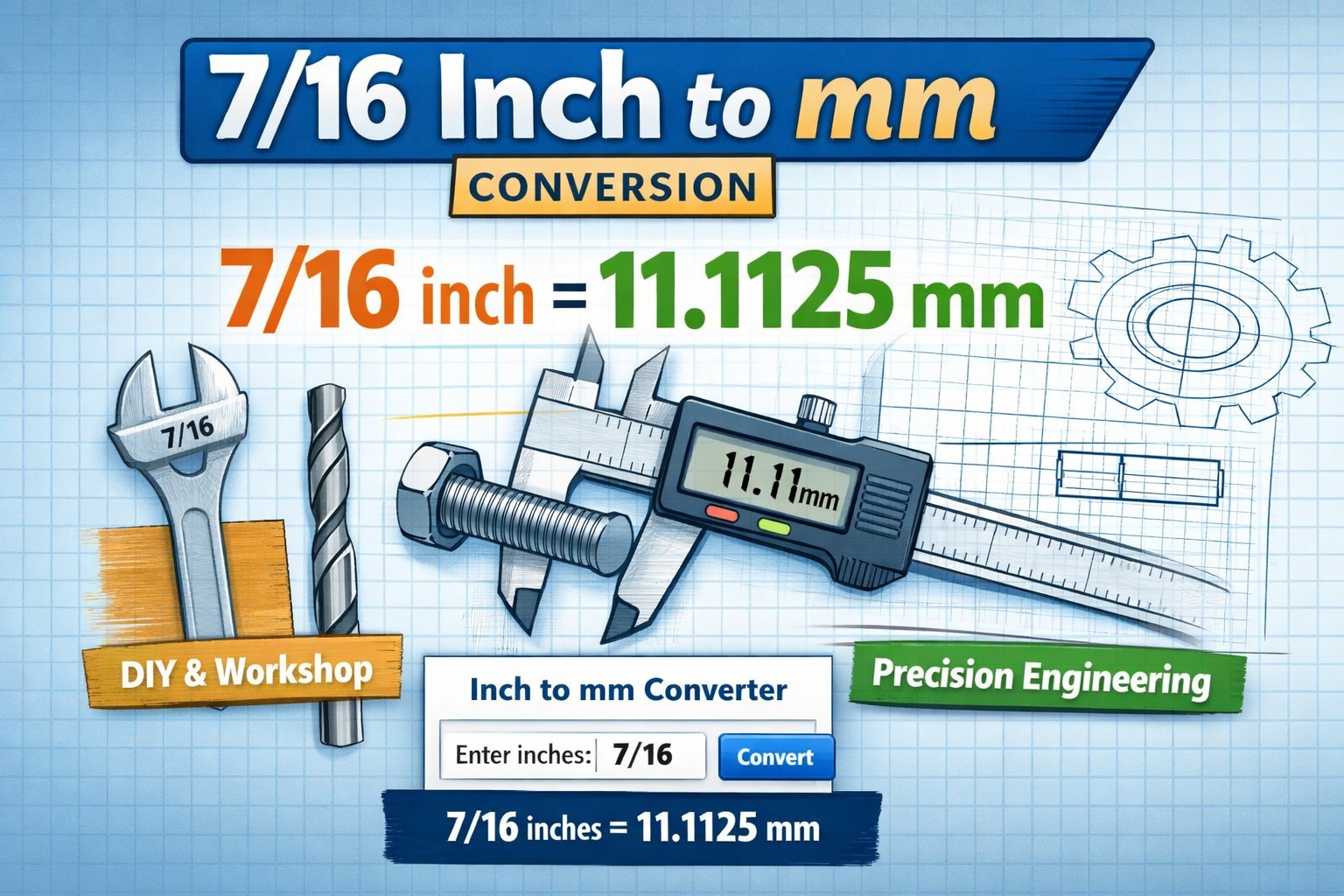
7/16 inch = 11.1125 millimeters (mm)
That’s the exact conversion using the standard formula. But if you’re working on real-world projects—whether it’s woodworking, mechanical repair, or DIY home improvements—there’s more to understand than just the number.
In this guide, I’ll walk you through the conversion, explain why it matters, show where it’s used, and even give you a simple HTML/CSS converter you can embed on your site.
Understanding the Conversion: Inches to Millimeters
The inch is part of the imperial system, commonly used in the United States, while millimeters belong to the metric system, used almost everywhere else.
The standard conversion is:
1 inch = 25.4 mm
So to convert inches to millimeters, you simply multiply:
inches × 25.4 = millimeters
Step-by-Step Conversion: 7/16 Inch to mm
Let’s break it down clearly:
- Convert the fraction to decimal
7 ÷ 16 = 0.4375 inches - Multiply by 25.4
0.4375 × 25.4 = 11.1125 mm
Final Answer:
7/16 inch = 11.1125 mm
Why This Conversion Matters
You might think this is just a small measurement, but 7/16 inch shows up in many real-world applications.
1. Mechanical and Automotive Work
Many bolts, nuts, and sockets use imperial sizing. A 7/16-inch wrench is extremely common in automotive repair.
2. Woodworking and Carpentry
Drill bits and fasteners often come in fractional inches. If you’re using metric tools, converting ensures accuracy.
3. Manufacturing and Engineering
Precision matters. Even a slight mismatch (say 11 mm vs 11.11 mm) can cause fitting issues in tight assemblies.
4. DIY and Home Projects
If you’ve ever bought hardware online or used imported tools, you’ve likely had to switch between units.
Rounded vs Exact Values
Depending on your project, you might not always need the exact number.
| Type of Work | Recommended Value |
|---|---|
| High precision (engineering) | 11.1125 mm |
| General DIY | 11.11 mm |
| Rough estimation | 11 mm |
Quick Tip:
If you’re drilling or fitting parts, always round carefully—rounding down vs rounding up can make a big difference.
Fraction-to-mm Conversion Table (Common Sizes)
Here’s a handy reference for similar sizes:
| Fraction (inches) | Decimal | Millimeters |
|---|---|---|
| 1/4 | 0.25 | 6.35 mm |
| 5/16 | 0.3125 | 7.9375 mm |
| 3/8 | 0.375 | 9.525 mm |
| 7/16 | 0.4375 | 11.1125 mm |
| 1/2 | 0.5 | 12.7 mm |
| 9/16 | 0.5625 | 14.2875 mm |
This table is especially useful when switching between drill bit sizes or socket sets.
Common Mistakes to Avoid
1. Using 11 mm Instead of 11.1125 mm
This might seem minor, but in tight tolerances, it can cause looseness or misalignment.
2. Forgetting Fraction Conversion
Some people try to multiply 7/16 directly without converting to decimal first—this leads to errors.
3. Rounding Too Early
Always complete the calculation first, then round at the end if needed.
When Should You Use Metric Instead?
Even in the U.S., metric is often preferred in:
- Electronics
- Engineering design
- Scientific measurements
- Imported tools and parts
If you’re working across systems, learning these conversions saves time and prevents mistakes.
DIY Inch to mm Converter
Inch to mm Converter
Real-Life Example: Using 7/16 Inch in Projects
Let’s say you’re installing a bolt labeled 7/16 inch, but your drill bit set is metric. You would convert 7/16 to 11.1125 mm and then choose the closest drill bit depending on the tolerance. For a tighter fit, you might go with 11.1 mm, while a slightly looser fit might use 11 mm.
Quick Mental Math Trick
You don’t always need a calculator. A simple shortcut is to multiply inches by 25 and then add a small extra amount (about 1.6%). For 0.4375 inches, this gets you very close to 11.11 mm, which is accurate enough for quick estimates.
Frequently Asked Questions
Is 7/16 inch exactly 11 mm?
No. It is 11.1125 mm, so 11 mm is slightly smaller.
What metric size is closest to 7/16 inch?
The closest common size is 11 mm, but it is not exact.
Can I substitute 11 mm for 7/16 inch?
Sometimes, yes—but only for low-precision tasks.
Final Thoughts
At first glance, converting 7/16 inch to mm seems simple, but in practical use, accuracy matters. The exact value is 11.1125 mm, and knowing when to use that precision versus a rounded number can make a real difference in your results.