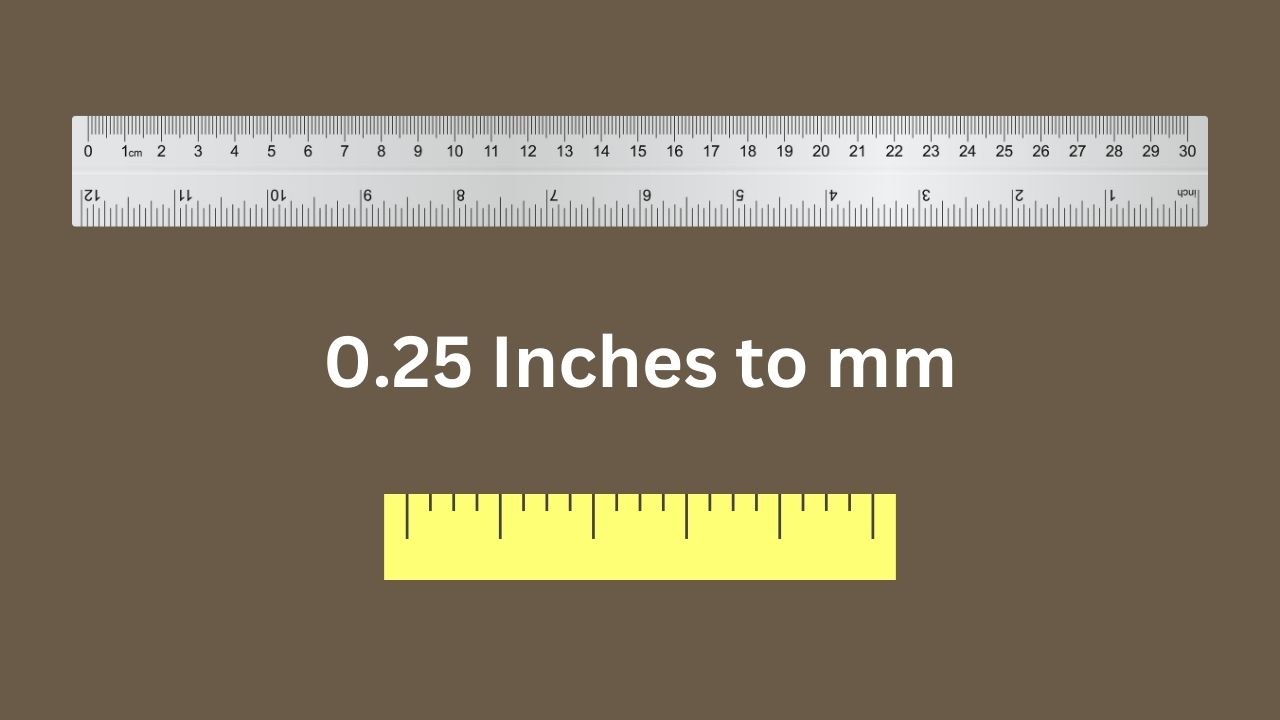
If you’re here looking for a quick answer, let’s not make you wait.
0.25 inches = 6.35 millimeters (mm)
That’s it. One quarter of an inch converts exactly to 6.35 mm.
But here’s the thing—this tiny number shows up in more places than you might expect. From tools and hardware to DIY projects, 3D printing, machining, woodworking, and even everyday household measurements, 0.25 inches to mm is a conversion people constantly search for. And if you’ve ever paused mid-project thinking, “Wait… how many millimeters is that again?”, you’re not alone.
Let’s break this down in a way that actually sticks, without sounding like a boring math textbook.
Understanding Inches and Millimeters (Without the Headache)
Before we dive deeper into the conversion, it helps to understand why inches and millimeters even exist in the first place.
What Is an Inch?
An inch is part of the imperial system, commonly used in the United States. It’s a familiar unit—rulers, tape measures, screws, bolts, and lumber sizes often rely on inches.
Some quick facts about inches:
- 1 inch is divided into fractions like 1/2, 1/4, 1/8, and so on
- Inches are often used in construction, carpentry, and household measurements
- Fractions like 0.25 inches are very common in real-world use
What Is a Millimeter?
A millimeter belongs to the metric system, which is used by most of the world. It’s a smaller, more precise unit.
Some quick facts about millimeters:
- 10 mm = 1 centimeter
- 1,000 mm = 1 meter
- Millimeters are widely used in engineering, manufacturing, medicine, and science
The key difference? Metric units scale cleanly by tens, while inches rely on fractions.
The Exact Conversion: 0.25 Inches to mm
Now let’s talk numbers.
The official conversion rate is:
1 inch = 25.4 millimeters
So when you convert 0.25 inches:
0.25 × 25.4 = 6.35 mm
There’s no rounding here. 6.35 mm is the exact value.
That’s why you’ll often see this number show up in technical drawings, product specs, and precision tools.
Why .25 Inches Shows Up So Often
A quarter inch might sound small, but it’s incredibly common.
Common Places You’ll See 0.25 Inches
- Drill bit sizes
- Screws and bolts
- Sheet materials
- Wood thickness
- Pipe diameters
- 3D printer nozzle references
- CNC and machining tolerances
When these specs are shared internationally, millimeters are often preferred, which makes 6.35 mm the go-to equivalent.
Visualizing 0.25 Inches vs 6.35 mm
Numbers are great, but let’s make this real.
Imagine a standard ruler:
- One inch is clearly marked
- Half an inch is easy to spot
- A quarter inch is exactly halfway between 0 and 0.5 inches
Now imagine that same length on a metric ruler. That distance lines up almost perfectly at 6.35 mm—just over 6 millimeters, not quite 6.5.
Once you see it side by side, the conversion feels far less abstract.
Is 6.35 mm the Same as 6 mm?
Short answer: No
This is where mistakes often happen.
- 6 mm is smaller than 0.25 inches
- 6.35 mm is the correct match
- The difference (0.35 mm) might sound tiny, but in precision work, it matters
In woodworking or casual DIY, rounding might be okay. In machining, engineering, or manufacturing, rounding can cause parts not to fit properly.
Quick Reference Table for Similar Conversions
Here’s a handy comparison to put things into perspective:
- 0.125 inches = 3.175 mm
- 0.25 inches = 6.35 mm
- 0.5 inches = 12.7 mm
- 0.75 inches = 19.05 mm
- 1 inch = 25.4 mm
Notice a pattern? Many inch fractions convert to millimeters with decimals ending in 0.35, 0.7, or 0.05. That’s because 25.4 doesn’t divide neatly into most fractions.
When Precision Really Matters
Sometimes being “close enough” is fine. Sometimes it’s not.
Situations Where Exact Conversion Is Important
- CNC machining
- Metal fabrication
- Engineering drawings
- Automotive parts
- Aerospace components
- Medical devices
- 3D printing tolerances
In these cases, 6.35 mm must be used, not 6 mm or 6.4 mm.
Situations Where Rounding Might Be Okay
- Rough carpentry
- Home DIY projects
- Visual spacing
- Craft projects
- Non-load-bearing parts
Even then, it’s good practice to know the exact value before deciding to round.
Why the Metric System Loves Millimeters
Millimeters shine when precision matters.
Instead of saying “a quarter inch,” metric users say “6.35 mm.” It’s specific, measurable, and leaves no room for interpretation.
That’s why technical industries worldwide lean toward millimeters—even in countries that still use inches casually.
How to Convert Inches to mm on Your Own
If you want to convert inches to millimeters without Googling every time, remember this simple rule:
Multiply inches by 25.4
Examples:
- 0.25 inches × 25.4 = 6.35 mm
- 2 inches × 25.4 = 50.8 mm
- 0.1 inches × 25.4 = 2.54 mm
Once you do it a few times, it becomes second nature.
Common Mistakes to Avoid
Let’s save you from a few classic slip-ups.
Mistake 1: Rounding Too Early
Always convert first, then round if needed.
Mistake 2: Mixing Units
Don’t mix inches and millimeters in the same measurement unless clearly labeled.
Mistake 3: Assuming Fractions Are “Close Enough”
A quarter inch is not “about 6 mm.” It’s 6.35 mm, and that difference can matter.
Fun Fact: Why 25.4?
The inch wasn’t always standardized. In the past, its length varied by country. In 1959, an international agreement defined 1 inch as exactly 25.4 mm. That’s why today’s conversions are clean and consistent.
So every time you convert .25 inches to mm, you’re using a globally agreed-upon standard.
Final Answer (One Last Time, Just to Be Clear)
Let’s end where we began, because clarity matters.
0.25 inches equals 6.35 millimeters.
Whether you’re measuring, building, designing, or just satisfying your curiosity, that number is solid, exact, and reliable.
And next time someone asks you, “What’s a quarter inch in millimeters?” you’ll have the answer—and the confidence—to say it without hesitation.