Let’s clear this up right away.
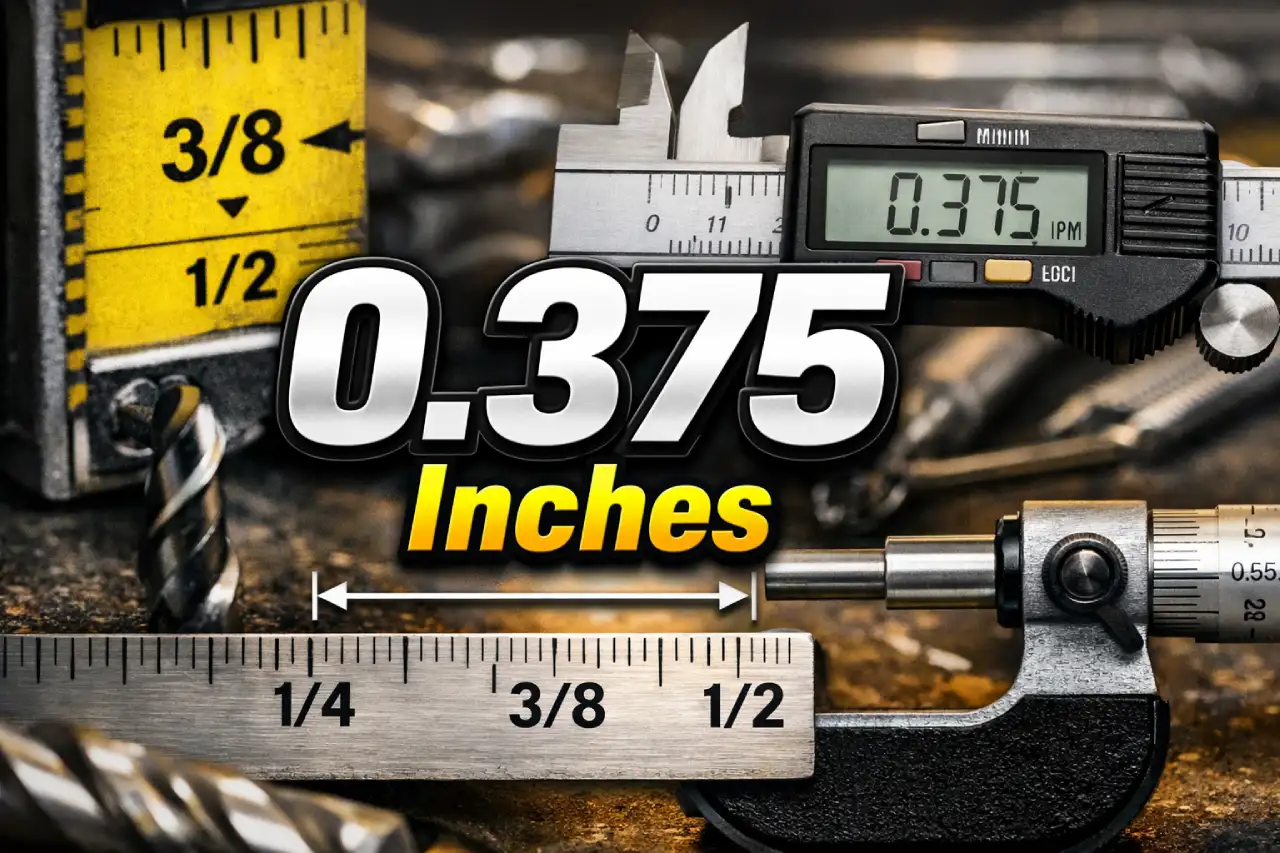
0.375 inches equals 3/8 of an inch.
That’s the direct answer, and if you’ve ever stared at a ruler wondering what 0.375 in inches actually means, you’re not alone. This number pops up everywhere—tools, hardware, woodworking plans, engineering drawings, product specifications—and yet it often causes unnecessary confusion.
The good news? Once you understand where 0.375 comes from and how it’s used, it becomes one of the easiest measurements to recognize and remember.
What Does 0.375 Inches Actually Mean?
At first glance, 0.375 inches looks like an awkward decimal. But it’s much friendlier than it seems.
The Fraction Behind the Decimal
0.375 inches is simply another way of writing 3/8 inch.
Here’s how it breaks down:
- 1/8 inch = 0.125
- 2/8 inch (or 1/4) = 0.25
- 3/8 inch = 0.375
So if you see 0.375 on a spec sheet or drawing, your brain should immediately translate it to three-eighths of an inch.
Why 3/8 Inch Is Such a Common Size
Three-eighths of an inch hits a sweet spot. It’s not tiny, not bulky, and strong enough for many everyday uses.
Common Uses of 0.375 Inches
- Bolts and fasteners
- Drill bits
- Plywood and material thickness
- Tool components
- Furniture hardware
- Mechanical parts
Because it’s so widely used, manufacturers often list it in decimal form (.375) rather than as a fraction, especially in technical documents.
How 0.375 Inches Looks on a Ruler
If decimals feel abstract, the ruler makes everything clearer.
On a standard inch ruler:
- One inch is divided into eighths
- Each small line represents 1/8 inch
- The third line from zero is 3/8 inch
That third tick mark is exactly where 0.375 inches lives.
Once you notice it, you’ll start spotting it everywhere.
Decimal Inches vs Fractional Inches
So why do we even bother writing inches as decimals?
Why Decimals Are Used
- Easier for calculations
- Preferred in engineering and machining
- Cleaner in spreadsheets and software
- No fractions to simplify
Why Fractions Still Matter
- Easier to read on physical rulers
- Common in construction and DIY
- Familiar to most people
That’s why the same measurement often appears in both forms: .375 inches (3/8 inch).
Is 0.375 Inches Bigger Than 1/4 Inch?
Yes—and noticeably so.
Let’s compare:
- 1/4 inch = 0.25
- 3/8 inch = 0.375
- 1/2 inch = 0.5
Three-eighths sits right between one-quarter and one-half inch. That’s why it’s often used when 1/4 feels too thin and 1/2 feels too bulky.
Converting 0.375 Inches to Other Units
Even though your focus might be inches, this number often needs to be converted.
0.375 Inches to Millimeters
Using the standard conversion:
- 1 inch = 25.4 mm
- 0.375 × 25.4 = 9.525 mm
So:
0.375 inches = 9.525 millimeters
This exact value matters in machining and manufacturing, where rounding too early can cause fit issues.
Why Precision Matters With 0.375 Inches
Some people treat 0.375 inches as “about 3/8” and move on. That’s fine—until it’s not.
When Precision Is Critical
- Engineering drawings
- CNC machining
- Automotive parts
- Tool manufacturing
- Tight mechanical fits
In these cases, 0.375 inches is not “close enough” to 0.38. The exact value matters.
When Approximation Is Usually Fine
- DIY projects
- Woodworking
- Rough construction
- Visual alignment
The key is knowing when precision is required—and when it’s safe to relax.
Why This Measurement Confuses So Many People
The confusion usually comes from switching between formats.
Someone sees:
- 3/8 inch on a ruler
- 0.375 inches in a manual
- 9.525 mm on a spec sheet
They’re all the same measurement—just written differently.
Once you connect those dots, the confusion disappears.
Quick Comparison Table for Context
Here’s where .375 inches fits among common sizes:
- 0.25 inches = 1/4 inch
- 0.375 inches = 3/8 inch
- 0.5 inches = 1/2 inch
- 0.75 inches = 3/4 inch
Seeing it in sequence helps your brain place it correctly.
Real-Life Situations Where You’ll See 0.375 Inches
You’ll encounter this measurement when:
- Buying drill bits or bolts
- Reading assembly instructions
- Measuring material thickness
- Working with mechanical parts
- Comparing metric and imperial specs
Knowing exactly what it means saves time and prevents mistakes.
A Quick Tip for Remembering 0.375
Here’s a simple memory trick:
- Think of eighths
- Count three of them
- Three-eighths = 0.375
Once you lock that in, you’ll never need to double-check it again.
Final Answer (Clear and Simple)
Let’s wrap this up cleanly.
0.375 inches equals 3/8 of an inch.
It’s a common, practical, widely used measurement—and now you know exactly where it fits, how it’s written, and why it shows up so often.
The next time you see 0.375 in inches, you’ll know it’s not strange or complicated. It’s just three-eighths, doing its job.