Let’s get the answer out of the way first, because clarity matters.
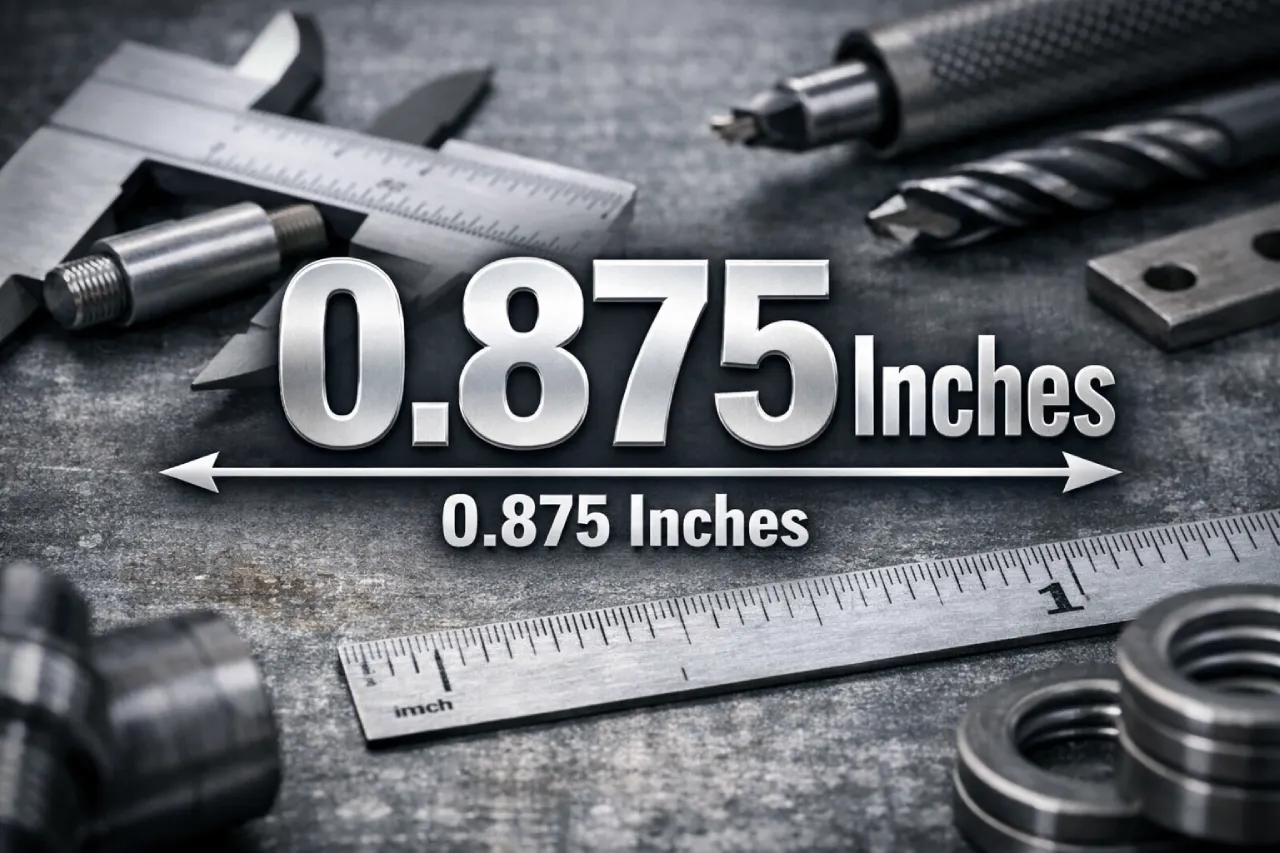
0.875 inches equals 7/8 of an inch.
That’s it. If you’ve been staring at 0.875 in inches on a ruler, blueprint, tool description, or product spec and wondering what it translates to, it’s simply seven-eighths of an inch written in decimal form.
Now here’s the fun part: this measurement shows up far more often than people expect. And once you understand it properly, it becomes one of the easiest sizes to recognize—no calculator, no second-guessing, no frustration.
What Does 0.875 Inches Actually Represent?
At first glance, 0.875 inches looks like an odd decimal. It feels less friendly than something like ½ or ¾. But it’s actually very logical.
The Fraction Behind the Decimal
Let’s break it down using eighths:
- 1/8 inch = 0.125
- 2/8 inch = 0.25
- 4/8 inch (½) = 0.5
- 6/8 inch (¾) = .075
- 7/8 inch = 0.875
So every time you see 0.875, your brain should immediately think seven-eighths.
Once you make that mental connection, the confusion disappears.
Why 7/8 Inch Is Such a Common Size
Seven-eighths of an inch sits right below a full inch. That makes it incredibly useful when you need something strong, thick, or sturdy—but not quite a full inch.
Common Uses of 0.875 Inches
- Heavy-duty bolts and fasteners
- Tool handles and shafts
- Mechanical components
- Furniture parts
- Construction hardware
- Equipment fittings
Because it’s widely used in manufacturing and engineering, it often appears as 0.875 inches instead of 7/8 inch in technical documents.
Where 0.875 Inches Sits on a Ruler
This is where everything clicks visually.
On a standard inch ruler:
- Each small line represents 1/8 inch
- The second-to-last mark before 1 inch is 7/8 inch
- That mark equals 0.875 inches
It’s right there—just one small step away from a full inch.
Once you spot it a few times, your eyes will find it instantly.
Decimal Inches vs Fractional Inches: Why Both Exist
So why not just stick with fractions?
Why Decimals Are Widely Used
- Easier for math and calculations
- Preferred in engineering and machining
- Cleaner in CAD software and spreadsheets
- Avoids working with fractions
Why Fractions Still Matter
- Easier to read on physical rulers
- Common in construction and DIY
- Familiar to most people
That’s why 0.875 inches and 7/8 inch are both correct—and often used side by side.
Is 0.875 Inches Almost One Inch?
Yes—but “almost” can still matter.
Let’s compare:
- 7/8 inch = 0.875
- 1 inch = 1.000
The difference is .125 inches, which is 1/8 inch. In some situations, that difference is huge.
When That Difference Matters
- Engineering tolerances
- Tool fitting
- Mechanical assemblies
- Load-bearing components
Calling 0.875 “basically an inch” can cause real problems in precision work.
Converting 0.875 Inches to Other Units
Even if you mostly work in inches, conversions often come up.
0.875 Inches to Millimeters
Using the standard conversion:
- 1 inch = 25.4 mm
- 0.875 × 25.4 = 22.225 mm
So:
0.875 inches equals 22.225 millimeters
This exact value matters in machining and manufacturing, where small errors add up fast.
Why Precision Matters With 0.875 Inches
In casual projects, people might round 0.875 to 0.88 or just call it “almost an inch.” That’s fine—until precision matters.
When Precision Is Critical
- CNC machining
- Engineering drawings
- Automotive parts
- Tool manufacturing
- Tight mechanical fits
In these cases, 0.875 inches must stay exact.
When Approximation Is Usually Fine
- Woodworking
- Home improvement
- Rough construction
- Visual spacing
The trick is knowing when exact numbers matter—and when they don’t.
Why This Measurement Confuses So Many People
Most confusion comes from format switching.
You might see:
- 7/8 inch on a ruler
- 0.875 inches in a manual
- 22.225 mm on a technical spec
They’re all the same measurement, just written in different systems.
Once you recognize that, reading measurements becomes much easier.
Quick Comparison With Familiar Sizes
Here’s where .875 inches fits among common measurements:
- 0.75 inches = 3/4 inch
- 0.875 inches = 7/8 inch
- 1 inch = 1 inch
Seeing it lined up like this helps your brain lock it into place.
A Simple Way to Remember 0.875
Here’s an easy memory trick:
- Think in eighths
- One inch is 8/8
- One step back is 7/8
- 7/8 = 0.875
Once you remember that, you’ll never need to look it up again.
Real-Life Situations Where You’ll See 0.875 Inches
You’ll commonly encounter this measurement when:
- Buying heavy-duty hardware
- Reading equipment manuals
- Measuring shafts or rods
- Working with mechanical tools
- Comparing metric and imperial specs
Knowing exactly what it means saves time, prevents mistakes, and builds confidence.
Final Answer (Clear and Simple)
Let’s wrap this up cleanly.
0.875 inches equals 7/8 of an inch.
It’s a practical, widely used measurement that sits just below a full inch—and now you know exactly what it means, where it’s used, and why it matters.
The next time you see 0.875 in inches, you won’t pause or guess. You’ll know it instantly.