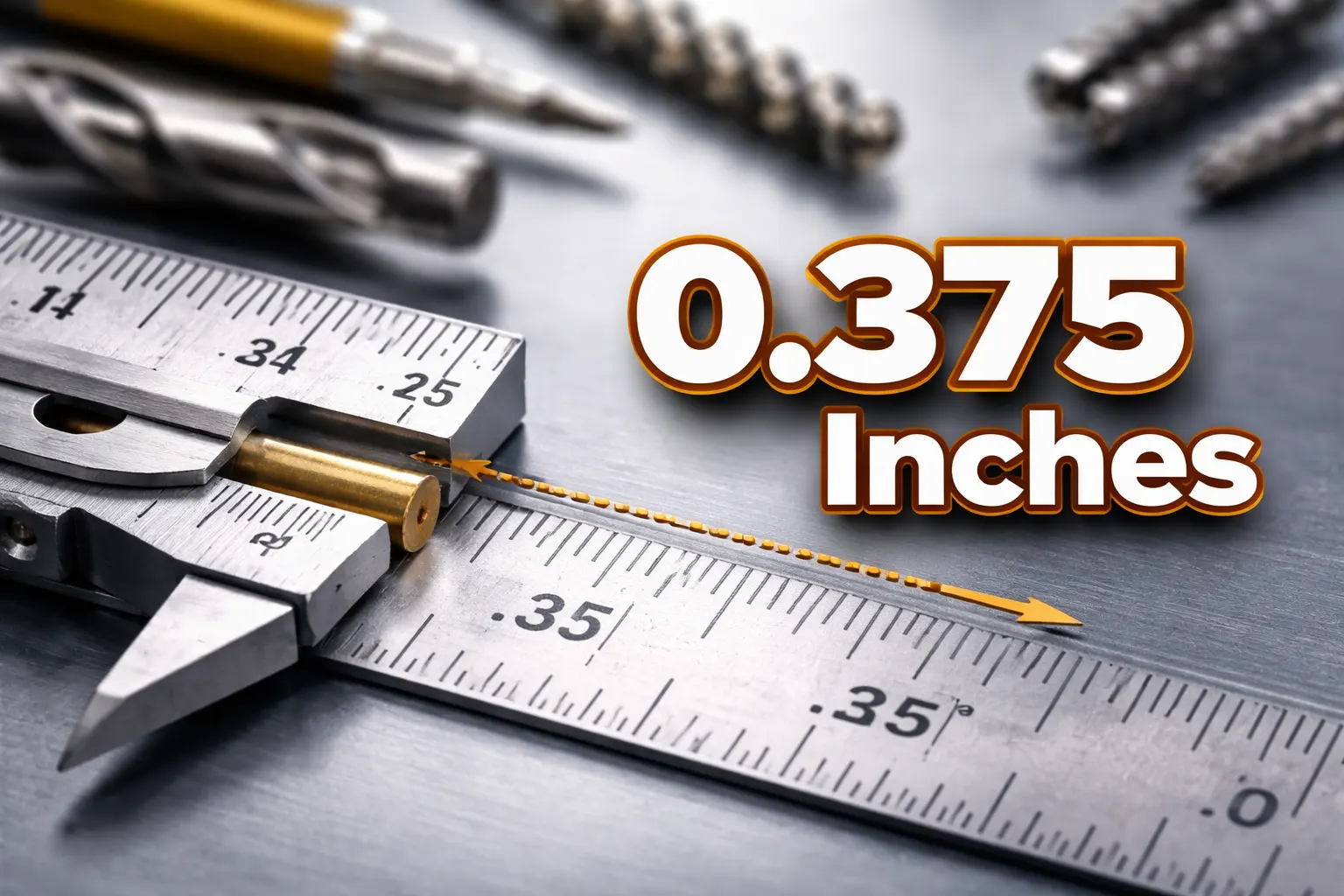
Let’s answer the question straight away, because this one has a very satisfying result.
0.375 inches is exactly equal to 3/8 inch.
No rounding. No approximation. No debate.
If you’ve ever looked at a measurement written as 0.375 and wondered what it actually means on a ruler, you’re not alone. This number shows up constantly in tools, plans, hardware, and specifications, and once you understand it, you’ll start spotting it everywhere.
This article breaks it down in a clear, human way, so you don’t just memorize the answer but actually understand it.
Why People Ask “What Is 0.375 in Inches?”
At first glance, the question sounds a bit odd. After all, 0.375 is already in inches. But what people are really asking is one of these things:
- What fraction is 0.375 inches?
- Where does 0.375 land on a ruler?
- Is 0.375 the same as 3/8 inch?
- How do I measure 0.375 inches in real life?
These are all practical questions, especially if you’re working with your hands instead of staring at a calculator.
The Simple Truth About 0.375 Inches
Let’s break it down step by step.
An inch can be divided into fractions. One of the most common is 1/8.
Now do the math:
1 ÷ 8 = 0.125
Multiply that by 3:
0.125 × 3 = 0.375
That means:
0.375 inches = 3/8 inch
Exactly. Cleanly. Permanently.
Decimal Inches vs Fractional Inches
This is where confusion usually starts.
Decimal inches are common in:
- CAD drawings
- Digital calipers
- Engineering specs
- CNC machines
Fractional inches are common on:
- Rulers
- Tape measures
- Construction plans
- Hardware packaging
They describe the same measurements, just in different formats.
Decimals are great for math. Fractions are great for measuring by eye.
Why 0.375 Inches Is Such a Common Number
You’ll see 0.375 everywhere because 3/8 inch is one of the most widely used measurements in the U.S.
It’s common in:
- Drill bit sizes
- Bolt and screw diameters
- Wood thickness references
- Metal stock
- Mechanical components
Because 3/8 inch is so common, its decimal form, 0.375, naturally appears in technical documents.
Where Is 0.375 Inches on a Ruler?
If you’re holding a ruler marked in eighths, this is easy.
Start at zero.
Count three small 1/8-inch marks.
That third mark is 3/8 inch, which is 0.375 inches.
If your ruler is marked in sixteenths, 3/8 inch equals 6/16.
So you’ll count six of the smallest marks.
Visualizing 0.375 Inches Without Numbers
If numbers blur together, here’s a simple way to picture it.
- 1/4 inch is noticeable but small
- 1/2 inch feels chunky
- 3/8 inch sits comfortably in between
That middle ground is where 0.375 inches lives.
Once you visualize it this way, you stop second-guessing yourself.
Common Mistakes People Make With 0.375 Inches
One common mistake is assuming 0.375 inches equals 1/4 inch. It doesn’t. 1/4 inch is 0.25 inches.
Another mistake is confusing 0.375 with 0.0375. That missing zero changes the measurement by a factor of ten.
Some people also assume 0.375 is an approximation. It’s not. It’s an exact decimal representation of 3/8 inch.
How 0.375 Inches Compares to Nearby Fractions
Let’s put it in context.
1/4 inch = 0.25
5/16 inch = 0.3125
3/8 inch = 0.375
7/16 inch = 0.4375
1/2 inch = 0.5
Seeing it in a lineup makes its position obvious.
Why Engineers Love Writing 0.375 Instead of 3/8
In technical fields, decimals are easier to calculate with.
Adding, subtracting, and scaling decimals is faster and less error-prone than juggling fractions. That’s why you’ll often see 0.375 inches in designs, even though the physical measurement is 3/8 inch.
It’s the same measurement, just written in a way machines and math prefer.
A Quick Mental Check You Can Use Anytime
Here’s a simple trick.
If the decimal ends in 0.125, 0.250, 0.375, or 0.500, it almost certainly corresponds to an eighth-inch fraction.
- 0.125 = 1/8
- 0.250 = 1/4
- 0.375 = 3/8
- 0.500 = 1/2
This shortcut saves a lot of time.
Real-World Situations Where 0.375 Inches Matters
You’ll encounter this measurement when:
- Choosing drill bits
- Buying bolts or threaded rods
- Measuring wood stock
- Reading blueprints
- Setting machine tolerances
Knowing instantly that 0.375 inches equals 3/8 inch makes these tasks smoother and faster.
Why Precision Still Matters Here
Even though 3/8 inch is common, precision still counts.
If you accidentally substitute 5/16 or 7/16 inch, the difference can cause loose fittings, alignment problems, or structural weakness.
Exact measurements prevent small mistakes from turning into big ones.
Quick Summary You Can Remember
Let’s lock it in clearly.
- 0.375 inches = 3/8 inch
- Exact conversion, no rounding
- Common on rulers, tools, and hardware
- Easy to spot once you know it
If you remember one thing, remember this: 0.375 and 3/8 are the same measurement.
Final Thoughts
Measurements don’t have to feel intimidating. Sometimes, they line up beautifully.
0.375 inches is one of those rare cases where the decimal and the fraction match perfectly. Once you understand that connection, you’ll stop pausing over specs and start measuring with confidence.
And the next time someone asks, “What is .375 in inches?”, you’ll have the answer instantly.