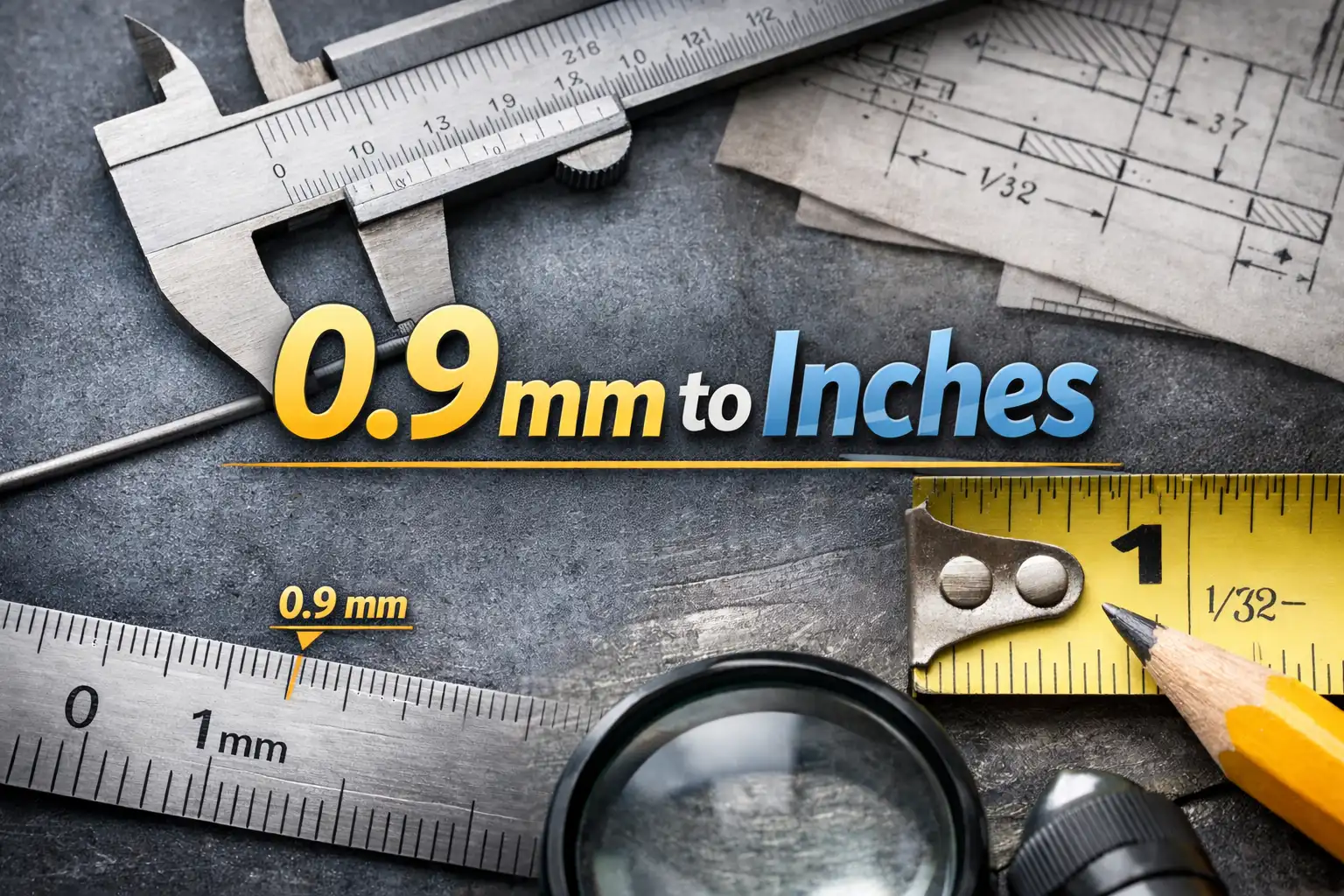
Let’s start with the answer you’re probably here for, nice and simple.
0.9 mm = .035433 inches
Rounded for everyday use, most people write it as 0.0354 inches.
That’s the accurate conversion. But like many tiny measurements, the real value of knowing this isn’t just about the number. It’s about understanding where 0.9 mm shows up, how small it actually is, and why converting it to inches matters so much in practical situations.
If you’ve ever paused over a specification, tool setting, or product detail wondering what 0.9 mm really means in inches, this guide is for you.
Why People Search for “0.9mm to Inches”
Millimeters and inches come from two different measuring systems that still coexist.
Millimeters dominate precision work, engineering, electronics, manufacturing, and global standards. Inches are still widely used in the U.S. for tools, hardware, DIY projects, and everyday measuring.
When those two systems overlap, conversions become unavoidable.
People commonly look up 0.9 mm to inches when dealing with:
- Mechanical or engineering drawings
- Wire and cable thickness
- Fasteners and screws
- Jewelry components
- Electronics and small parts
- 3D printing and machining specs
In these areas, even a small error can cause parts not to fit or function properly.
What 0.9 mm Really Represents
A millimeter is already a very small unit. 0.9 mm is smaller than most people expect.
To put it into perspective:
- It’s thinner than a standard credit card
- Slightly thicker than very fine wire
- Hard to see clearly on most rulers
- Common in tight tolerances and precision components
When converted to inches, it turns into a small decimal that doesn’t mean much unless you understand the scale.
The Exact Formula to Convert 0.9 mm to Inches
The conversion itself is straightforward and consistent.
1 inch = exactly 25.4 millimeters
This value is fixed internationally and never changes.
So the formula is:
Inches = Millimeters ÷ 25.4
Now apply it.
0.9 ÷ 25.4 = .03543307087
Rounded sensibly:
0.9 mm ≈ 0.0354 inches
For most real-world uses, four decimal places are more than enough.
Why 25.4 Is the Only Number You Need to Remember
The number 25.4 is the backbone of every millimeter-to-inch conversion.
It’s not an estimate. It’s an exact value agreed upon worldwide. That’s why conversions done on calculators, charts, and software always match.
Once you remember this number, conversions stop feeling mysterious and start feeling logical.
How Small Is 0.9 mm Compared to Common Inch Fractions?
Many people in the U.S. think in fractions, not decimals, so comparisons help.
1/32 inch =0 .03125 inches
0.9 mm = 0.03543 inches
1/16 inch = 0.0625 inches
That means 0.9 mm is slightly larger than 1/32 inch but much smaller than 1/16 inch.
This explains why it doesn’t line up cleanly with common ruler markings.
Why 0.9 mm Is a Common Measurement
Despite its size, 0.9 mm appears frequently in real-world applications.
You’ll see it in:
- Electrical and electronic wire diameters
- Precision screws and fasteners
- Jewelry wire and pins
- Mechanical tolerances
- Electronics spacing
- Certain metric hardware standards
In many of these cases, accuracy at the sub-millimeter level is critical.
Common Mistakes When Converting 0.9 mm to Inches
Small numbers invite big mistakes.
One common error is rounding too aggressively. Dropping .0354 inches down to .03 inches loses a noticeable amount of accuracy.
Another mistake is confusing 0.9 mm with 9 mm, which is ten times larger and a completely different size.
Some people also assume 0.9 mm is close to 1/16 inch. It’s not. 1/16 inch is almost twice as large.
A Simple Mental Math Shortcut
If you need a quick estimate and don’t need extreme precision, here’s a handy trick.
Divide the millimeter value by 25.
0.9 ÷ 25 ≈ 0.036 inches
That’s very close to the exact value of 0.0354 inches. It’s not perfect, but it’s great for fast thinking.
Conversion Table for Better Perspective
Seeing nearby values helps your brain understand the scale.
0.7 mm ≈ 0.0276 inches
0.8 mm ≈ 0.0315 inches
0.9 mm ≈ 0.0354 inches
1.0 mm ≈ 0.0394 inches
1.5 mm ≈ 0.0591 inches
Once you notice the pattern, estimating becomes much easier.
When Millimeters Are Better Than Inches
For very small measurements, millimeters are often easier to work with.
They avoid awkward fractions, scale cleanly, and are the global standard for technical and industrial work. That’s why CAD drawings, engineering documents, and international manufacturing usually default to millimeters.
Inches are great for everyday tasks. Millimeters shine when precision matters.
Real-World Situations Where 0.9 mm Matters
This measurement can be critical when:
- Selecting wire or cable sizes
- Choosing metric fasteners
- Adjusting machine clearances
- Designing tightly fitted components
- Reading international specifications
Knowing that 0.9 mm equals about 0.0354 inches helps you make confident decisions instead of relying on guesswork.
Why Small Errors Add Up Quickly
A single 0.9 mm difference might not look dramatic. But stack multiple components together, and the error multiplies fast.
Ten parts off by 0.9 mm create a 9 mm error, which is more than a third of an inch. That’s enough to cause serious alignment and fit problems.
Precision isn’t about being obsessive. It’s about preventing small issues from becoming big ones.
Final Thoughts
Let’s lock it in one last time.
0.9 mm = 0.035433 inches
For everyday use, 0.0354 inches is perfectly accurate.
This small measurement appears in more places than most people realize. Once you understand it, conversions stop feeling intimidating and start feeling natural.
Small numbers matter. Especially when precision is the goal.