Let’s clear the confusion right at the start.
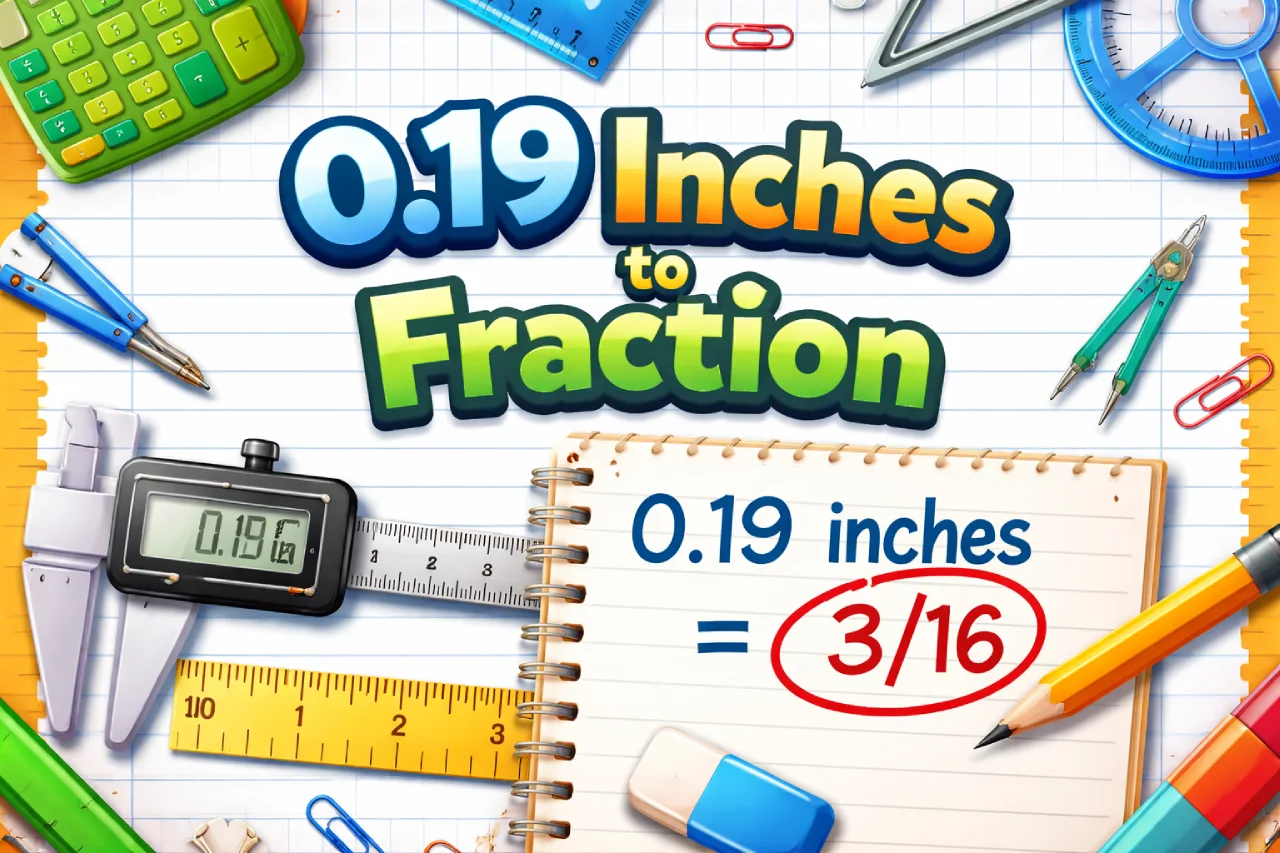
0.19 inches = 19/100 inch (exact)
That’s the mathematically correct fraction.
But here’s the real-world twist: you will never see 19/100 inch marked on a standard ruler or tape measure. So while the math answer is correct, it’s not very helpful when you’re actually measuring something with your hands.
That’s why people keep searching for “0.19 inches to fraction.” What they really want to know is: Which fraction should I use on a ruler? This article answers that clearly, without guesswork.
By the end, you’ll know the exact fraction, the closest practical fraction, and how to measure 0.19 inches with confidence.
Why People Search for “0.19 Inches to Fraction”
Decimal inches show up everywhere today.
You’ll see 0.19 inches in:
- CAD and design software
- Engineering drawings
- Digital calipers
- Online calculators
- Product specifications
But most physical measuring tools in the U.S. still use fractions, not decimals.
That mismatch creates confusion.
People aren’t just asking for math. They’re asking, “Where does this land on my ruler?”
Decimal Inches vs Fractional Inches (Quick Reality Check)
Decimal inches divide an inch into tenths or hundredths.
Fractional inches divide an inch into halves, quarters, eighths, sixteenths, and so on.
Decimals are excellent for calculations.
Fractions are better for hands-on measuring.
Understanding how to move between the two is what makes measuring feel easy instead of frustrating.
The Exact Fraction for 0.19 Inches
Let’s start with pure math.
0.19 means nineteen hundredths.
So:
0.19 inches = 19/100 inch
This is exact. No rounding. No approximation.
From a mathematical standpoint, this is the correct fraction.
But now comes the practical problem.
Why 19/100 Inch Isn’t Useful on a Ruler
Standard rulers are not divided into hundredths.
Most rulers are marked in:
- 1/2
- 1/4
- 1/8
- 1/16
- Sometimes 1/32
You won’t find 19/100 inch anywhere on them.
So while 19/100 inch is correct on paper, it’s not useful when you’re measuring wood, metal, or parts in real life.
That’s why most people really want the closest standard fraction.
Finding the Closest Common Fraction to 0.19 Inches
Let’s compare 0.19 inches to familiar fractions.
3/16 inch = 0.1875
1/4 inch = 0.25
Now check the differences.
Difference between 0.19 and 3/16:
0.19 − 0.1875 = 0.0025
Difference between 0.19 and 1/4:
0.25 − 0.19 = 0.06
That makes the answer very clear.
3/16 inch is much closer to 0.19 inches than 1/4 inch.
So in real-world measuring:
0.19 inches ≈ 3/16 inch (closest standard fraction)
A Simple Conversion Trick Using Sixteenths
Here’s a method you can reuse anytime.
Multiply the decimal by 16.
0.19 × 16 = 3.04
Round to the nearest whole number.
That gives you 3/16 inch.
This works well because most rulers are marked in sixteenths.
How Accurate Is 3/16 Inch Compared to 0.19 Inches?
Let’s compare the numbers directly.
3/16 inch = 0.1875
0.19 inches = 0.1900
Difference = 0.0025 inches
That’s extremely small.
For woodworking, DIY projects, hardware fitting, and general measuring, this difference is usually negligible.
For ultra-precision machining, you’d stick with decimals. But for most real-world work, 3/16 inch is an excellent match.
When to Use 19/100 Inch vs 3/16 Inch
Here’s a simple rule that keeps things clear.
Use 19/100 inch when:
- Doing calculations
- Working in design or CAD software
- Reading digital calipers
- Writing specifications
Use 3/16 inch when:
- Measuring with a ruler or tape
- Cutting materials
- Drilling holes
- Doing DIY, carpentry, or home projects
Knowing both saves time and prevents mistakes.
Visualizing 0.19 Inches Without Math
If numbers blur together, try this mental picture.
- 1/8 inch is clearly smaller
- 1/4 inch is clearly bigger
- 0.19 inches sits just above 3/16
On a ruler, you’ll land almost exactly on 3/16 inch.
Once you see that relationship, it becomes easy to spot.
Common Mistakes People Make
One common mistake is rounding 0.19 inches up to 1/4 inch. That’s far too large.
Another mistake is rounding down to 1/8 inch, which is too small.
Some people also confuse 0.19 inches with 0.019 inches, which is ten times smaller and completely different.
Decimals require careful attention.
Why This Conversion Feels Confusing
The math is simple. The ruler is the problem.
Rulers don’t use hundredths, so your brain understands the number, but your hands can’t find it directly.
That’s why understanding practical fractions matters just as much as knowing exact ones.
Real-World Situations Where 0.19 Inches Appears
You’ll encounter this measurement in:
- Hardware specifications
- Tool manuals
- Mechanical drawings
- Product dimensions
- Digital caliper readings
Knowing the closest usable fraction helps you move from screen to shop without guessing.
A Quick Reference You Can Remember
Let’s lock it in clearly.
- Exact fraction: 19/100 inch
- Closest standard fraction: 3/16 inch
- Best for rulers: 3/16
- Best for math: 19/100
If you remember one thing, remember 3/16 inch for measuring.
Why Small Differences Still Matter
Even a difference of 0.0025 inches can matter in stacked components or tight assemblies.
Precision isn’t about perfection. It’s about consistency.
Using the correct fraction keeps your work accurate and repeatable.
Final Thoughts
Decimal-to-fraction conversions don’t have to be confusing. Once you understand how rulers are actually divided, everything clicks.
0.19 inches may look awkward at first, but it fits cleanly into real-world measuring when you know where to look.
Knowing the difference between exact fractions and usable fractions makes you faster, more confident, and far less likely to guess.
And when measuring stops being guesswork, every project turns out better.