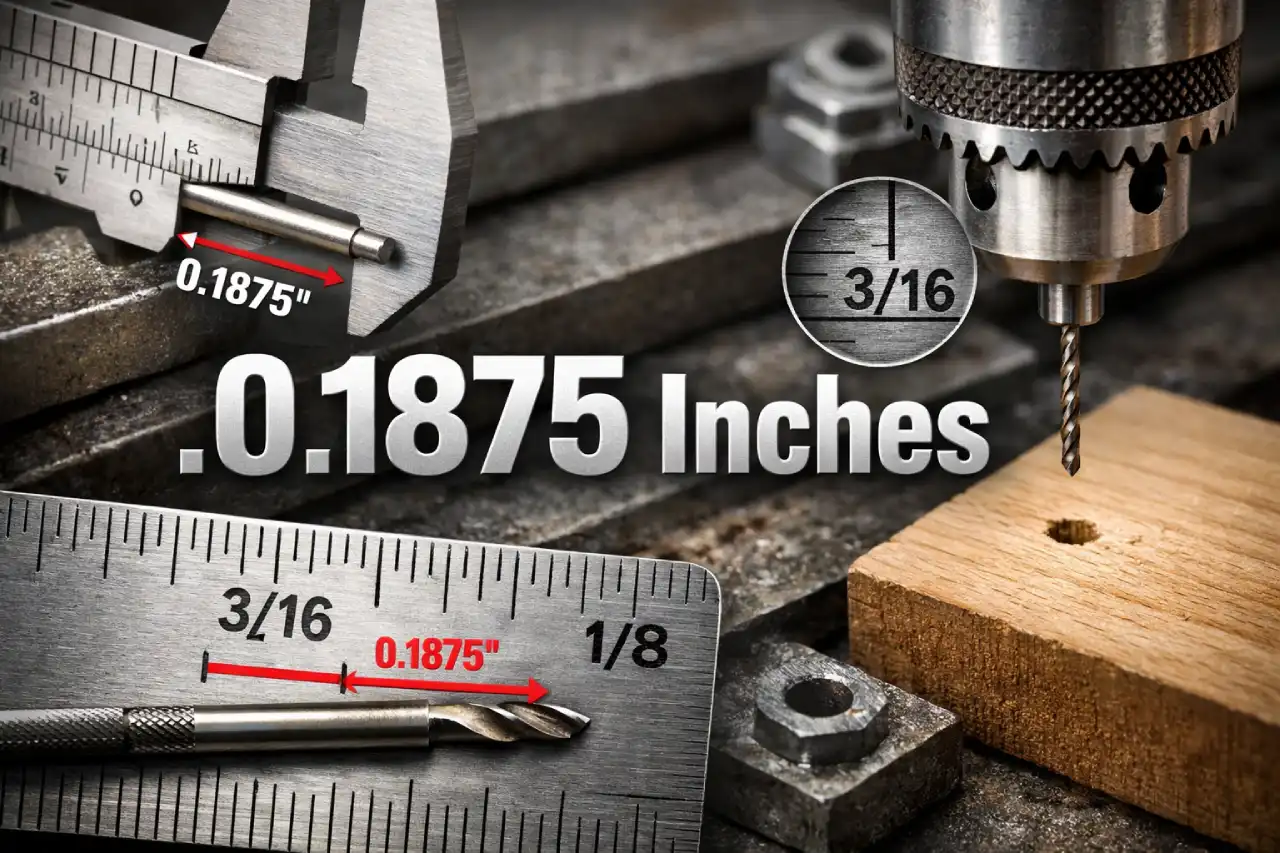
Let’s clear this up right away, because this number actually hides a very satisfying answer.
0.1875 inches = 3/16 inch (exact)
No rounding. No approximation. No “close enough.”
If you’ve searched for “0.1875 in inches,” you were probably staring at a digital caliper, a spec sheet, or a design file and thinking, Why does this number look so specific? The reason is simple: 0.1875 inches is one of the cleanest decimal-to-fraction conversions you’ll ever see.
This article breaks down what 0.1875 inches really means, why it shows up so often, how to spot it instantly on a ruler, and how to avoid common mistakes people make with similar-looking decimals.
Why People Search for “0.1875 in Inches”
At first glance, the phrase sounds redundant. After all, 0.1875 is already in inches.
But people search this because they encounter 0.1875 inches in:
- Digital calipers
- Engineering drawings
- CAD software
- Machining specs
- Product dimensions
Then they pick up a ruler and realize something important.
.1875 inches lines up perfectly with a standard fraction.
Once you know which one, everything clicks.
What 0.1875 Inches Means in Plain English
Decimal inches divide one inch into hundredths or thousandths.
So:
0.1875 inches = one hundred eighty-seven and a half thousandths of an inch
That’s technically correct, but not very helpful.
What is helpful is this:
0.1875 inches = 3/16 inch
This is an exact conversion, not an estimate.
Why This Conversion Is So Clean
Let’s look at the math behind it.
1 inch ÷ 16 = 0.0625 inches
Now multiply:
0.0625 × 3 = 0.1875
That’s why 0.1875 inches equals exactly 3/16 inch.
No repeating decimals. No rounding errors. Just clean math.
Why 3/16 Inch Is Such a Common Measurement
The fraction 3/16 inch shows up everywhere because it’s:
- Easy to see on a ruler
- Large enough to measure accurately
- Small enough for precision work
That’s why it’s common in:
- Woodworking
- Construction
- Hardware sizing
- Mechanical parts
- DIY projects
When software converts 3/16 inch into decimal form, you get 0.1875 inches every time.
Where .1875 Inches Falls on a Ruler
If you’re holding a ruler right now, here’s how to find it instantly.
- Find the 1/8 inch mark
- Move to the next small line
- That next line is 3/16 inch
That mark is 0.1875 inches exactly.
No guessing required.
Is 0.1875 Inches the Same as 0.19 Inches?
This is a very common question, and the answer matters.
0.1875 inches = 3/16
0.19 inches = 19/100
Difference:
0.19 − .1875 = 0.0025 inches
They are close, but not the same.
In rough work, the difference may not matter. In precision work, it absolutely can.
Is 0.1875 Inches Bigger Than 1/8 Inch?
Yes.
1/8 inch = 0.125 inches
3/16 inch = 0.1875 inches
So:
- 0.1875 inches is larger than 1/8 inch
- It’s smaller than 1/4 inch
That places it neatly in the middle.
Is 0.1875 Inches the Same as .2 Inches?
No, and this mix-up happens often.
0.2 inches = 1/5 inch
0.1875 inches = 3/16 inch
Difference:
0.2 − 0.1875 = 0.0125 inches
That difference is large enough to cause fit issues in many projects.
Why .1875 Inches Shows Up So Often in Digital Tools
Digital tools love fractions that divide evenly into base numbers.
Because 16 divides cleanly into 1 inch, any fraction with a denominator of 16 converts nicely to decimals.
That includes:
- 1/16 = 0.0625
- 1/8 = 0.125
- 3/16 = 0.1875
- 1/4 = 0.25
That’s why 0.1875 inches appears frequently in software outputs.
Common Mistakes People Make With 0.1875 Inches
One common mistake is assuming 0.1875 inches is an approximation. It’s not.
Another mistake is rounding it up to 0.19 inches, which introduces error.
Some people also confuse 0.1875 inches with 0.01875 inches, which is ten times smaller and completely different.
Decimals demand careful attention.
How to Convert 0.1875 Inches to Millimeters (Bonus Clarity)
While this article focuses on inches, some people naturally wonder about millimeters.
1 inch = 25.4 mm
So:
0.1875 × 25.4 = 4.7625 mm
That value is also exact.
So:
- 0.1875 inches = 3/16 inch = 4.7625 mm
When to Use the Decimal vs the Fraction
Use 0.1875 inches when:
- Reading digital calipers
- Working in CAD or design software
- Writing technical specifications
- Doing calculations
Use 3/16 inch when:
- Measuring with a ruler
- Cutting materials
- Drilling holes
- Doing hands-on work
Knowing when to switch keeps everything smooth.
Real-World Example
Imagine a bolt hole specified as 0.1875 inches in diameter.
If you grab a 3/16 inch drill bit, you’ve chosen the correct size.
If you grab a 0.19 inch bit instead, you’ve already introduced error.
That’s why understanding this conversion matters.
Why Clean Conversions Matter
Measurements like 0.1875 inches are a gift.
They convert cleanly, measure cleanly, and reduce mistakes.
The more you recognize these “friendly decimals,” the faster and more confident your measuring becomes.
Quick Summary You Can Remember
Let’s lock it in clearly.
- 0.1875 inches = 3/16 inch (exact)
- One of the cleanest decimal-to-fraction conversions
- Easy to spot on a ruler
- Common in woodworking, hardware, and machining
If you remember one thing, remember 3/16 inch.
Final Thoughts
Some measurements look complicated until you understand where they come from.
0.1875 inches isn’t random at all. It’s simply 3/16 inch wearing a decimal disguise. Once you see that, the number stops being intimidating and starts feeling familiar.
And when numbers feel familiar, measuring becomes faster, cleaner, and far more reliable.