At first glance, this question looks like it should have a clean, numeric answer.
“Zach has a z-score of 1.5. His height is ___ inches.”
But here’s the honest truth right up front:
You cannot calculate Zach’s exact height in inches from a z-score alone.
And that’s not a trick answer or a technical dodge. It’s actually the most important lesson hidden inside this problem.
A z-score of 1.5 tells us how Zach’s height compares to others, but it doesn’t tell us the actual height unless we also know two key things:
- The average (mean) height
- The standard deviation of heights
Once you understand how those pieces fit together, this type of problem becomes one of the easiest in statistics. Let’s break it down step by step, in plain English, with real examples that actually make sense.
What a Z-Score Really Means (Without the Jargon)
A z-score measures how far a value is from the average, using standard deviation as the unit.
Think of it like this.
The average height is the middle of the group.
The standard deviation tells you how spread out people are from that average.
The z-score tells you how many standard deviations above or below average someone is.
So when we say:
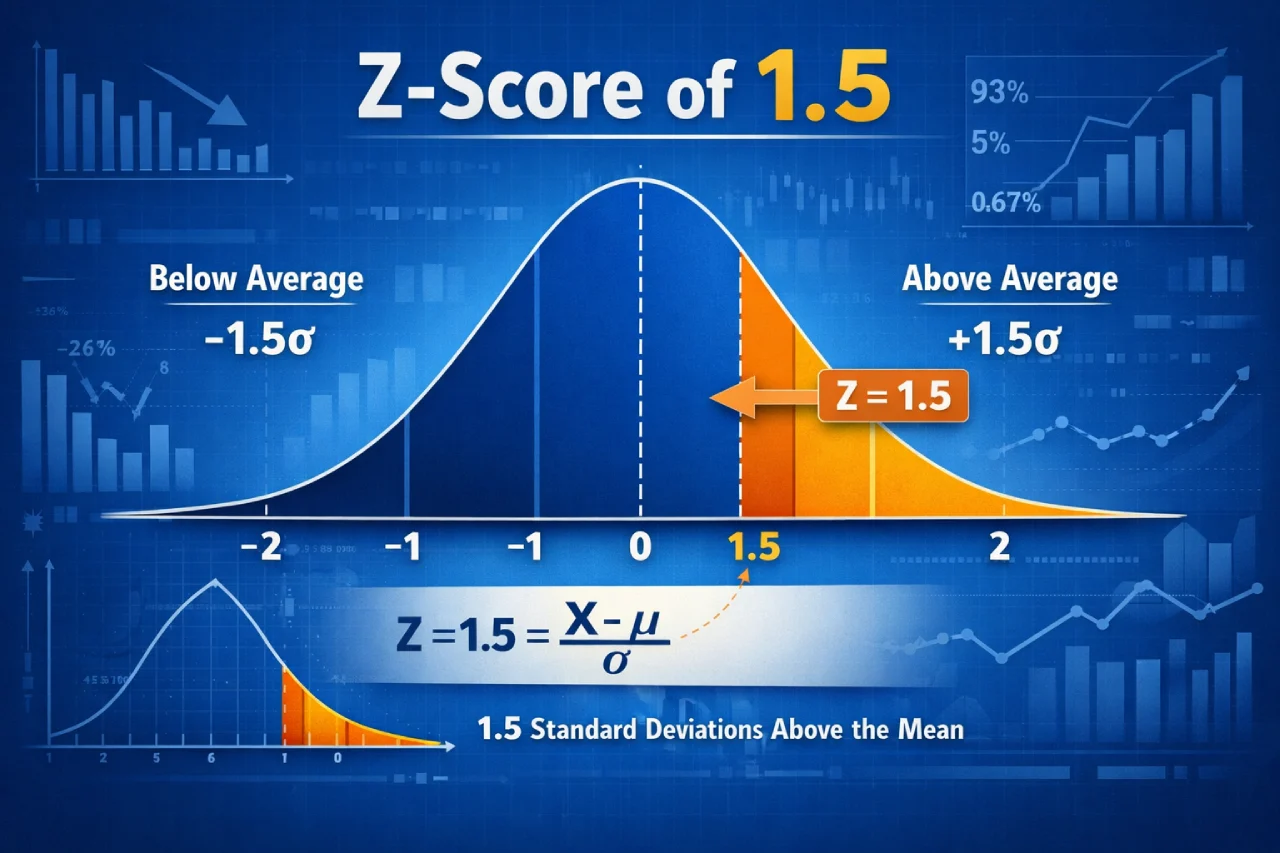
Zach has a z-score of 1.5
We are saying:
Zach is 1.5 standard deviations taller than the average person in that group.
That’s it. No inches yet. Just position.
Why You Can’t Find Zach’s Height Yet
This is where many students get stuck.
A z-score does not come with built-in inches, feet, or centimeters. It’s a relative measure.
To convert a z-score into an actual height, you must know:
- The mean height (μ)
- The standard deviation (σ)
Without those, the problem is incomplete.
But once you have them, the calculation is very simple.
The Formula That Connects Everything
Here’s the formula used to convert between height and z-score:
z = (x − μ) / σ
Where:
- z = z-score
- x = actual height (in inches)
- μ = mean height
- σ = standard deviation
To find Zach’s height, we rearrange the formula:
x = μ + zσ
This version is the one you’ll use most often in real problems.
What Zach’s Z-Score of 1.5 Tells Us Qualitatively
Even before we plug in numbers, we already know something important.
A z-score of 1.5 means:
- Zach is taller than average
- Zach is taller than about 93% of the population (in a normal distribution)
- Only about 7% of people are taller than him
So regardless of the exact inches, Zach is clearly on the tall side.
A Realistic Example With Actual Numbers
Let’s walk through a full example, because this is usually how the question appears in class or exams.
Suppose the problem says:
- The average height of males is 70 inches
- The standard deviation is 3 inches
- Zach’s z-score is 1.5
Now we have everything we need.
Step 1: Write the formula
x = μ + zσ
Step 2: Plug in the values
x = 70 + (1.5 × 3)
Step 3: Do the math
x = 70 + 4.5
x = 74.5 inches
Final Answer (in this scenario)
Zach’s height is 74.5 inches
That’s about 6 feet 2.5 inches, which matches what we’d expect for someone 1.5 standard deviations above average.
Why the Mean and Standard Deviation Matter So Much
Now imagine a different group.
Suppose:
- Mean height = 64 inches
- Standard deviation = 2 inches
- Zach’s z-score = 1.5
Then:
x = 64 + (1.5 × 2)
x = 64 + 3
x = 67 inches
Same z-score. Completely different height.
This is why the phrase “Zach has a z-score of 1.5” is not enough by itself to determine height.
Interpreting Zach’s Height Without Numbers
Even without inches, a z-score of 1.5 still tells us a lot.
It means:
- Zach is clearly above average
- He is taller than most people in his group
- His height is noticeably different, but not extreme
For comparison:
- z = 0 → exactly average
- z = 1 → taller than about 84% of people
- z = 1.5 → taller than about 93%
- z = 2 → taller than about 97.5%
Zach is tall, but not a statistical outlier.
Common Mistakes Students Make With This Question
This type of problem trips people up in predictable ways.
One common mistake is trying to guess the height without checking if the mean and standard deviation are given.
Another mistake is confusing z-score with percentile. A z-score measures distance from the mean, not ranking directly.
Some students also forget to multiply the z-score by the standard deviation before adding the mean.
And a big one: using the wrong formula direction.
If you’re finding height, use:
x = μ + zσ
Not the other way around.
Why Teachers Love This Question
This question isn’t really about height.
It’s about whether you understand:
- What a z-score represents
- How standard deviation works
- How relative measures turn into actual values
If you can explain why the height can’t be found without more information, you’re already thinking statistically.
How This Shows Up in Real Life
Z-scores aren’t just for math class.
They’re used in:
- Growth charts for children
- Standardized test scores
- Medical measurements
- Athletic performance data
- Quality control in manufacturing
In all these cases, the logic is the same. The z-score tells you where someone stands, not the raw measurement by itself.
A Quick Mental Check You Can Use
Any time you see a problem like this, ask yourself:
Do I know the mean?
Do I know the standard deviation?
If the answer is no to either one, you cannot find the actual value.
That check alone will save you from a lot of wrong answers.
Putting It All Together
Let’s summarize what we’ve learned.
- A z-score of 1.5 means Zach is 1.5 standard deviations above average
- You cannot find his height in inches without the mean and standard deviation
- Once those are given, the formula is:
height = mean + (z-score × standard deviation) - With realistic values, Zach would likely be somewhere between 67 and 75 inches, depending on the group
Final Thoughts
This problem looks like a math question, but it’s really a thinking question.
Understanding what a z-score represents is far more important than memorizing formulas. Once that clicks, the math becomes easy—and honestly, kind of satisfying.
So the next time you see:
“Zach has a z-score of 1.5. His height is ___ inches.”
You’ll know exactly what to ask next.
And that’s the real win.