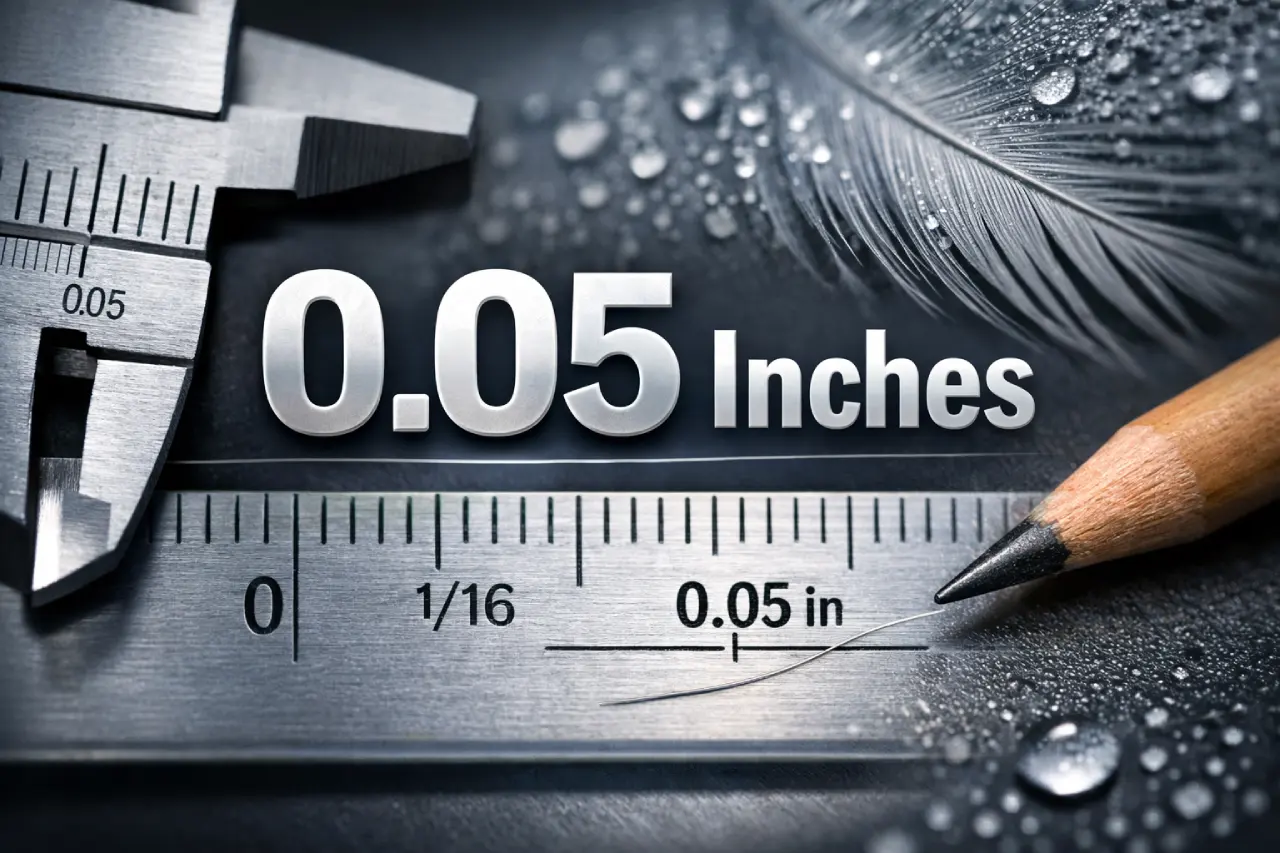
Let’s clear up the confusion right away.
0.05 is already a measurement in inches.
So when someone asks, “What is .05 in inches?” the literal answer is simple:
it is five hundredths of an inch.
But that’s almost never the real question.
What people actually want to know is:
- How small is 0.05 inches, really?
- What fraction of an inch is it?
- Can you measure it on a ruler?
- Is it closer to 1/16 or 1/32?
- Why does it show up so often in specs and tools?
That’s where things get interesting—and useful.
This article breaks down 0.05 inches in a practical, real-world way so you can understand it, visualize it, and use it confidently without guessing.
Why People Search for “0.05 in Inches”
At first glance, the phrase looks redundant. But it shows up constantly in searches because people encounter 0.05 inches in places like:
- Digital calipers
- Engineering drawings
- Machining tolerances
- Tool manuals
- Manufacturing specs
Then they grab a ruler… and nothing lines up neatly.
Most rulers are marked in fractions, not decimals. And 0.05 inches doesn’t land exactly on a common fraction, which is why people go looking for clarity.
What 0.05 Inches Means in Plain English
Decimal inches divide one inch into tenths and hundredths.
So:
0.05 inches = five hundredths of an inch
Written as a fraction:
0.05 inches = 5/100 = 1/20 inch (exact)
That is the mathematically correct fraction.
But here’s the catch.
Why 1/20 Inch Isn’t Helpful on a Ruler
Standard rulers are not divided into twentieths.
They’re usually marked in:
- 1/2
- 1/4
- 1/8
- 1/16
- Sometimes 1/32
You will never see 1/20 inch printed on a ruler.
So while 1/20 inch is correct on paper, it doesn’t help you measure anything by hand. That’s why most people really want to know:
What common ruler fraction is closest to 0.05 inches?
Finding the Closest Fraction to 0.05 Inches
Let’s compare 0.05 inches to familiar small fractions.
1/16 inch = 0.0625
1/32 inch = 0.03125
Now check the differences.
Difference between 0.05 and 1/16:
0.0625 − 0.05 = 0.0125
Difference between 0.05 and 1/32:
0.05 − 0.03125 = 0.01875
That tells us something important.
1/16 inch is closer to 0.05 inches than 1/32 inch.
So in practical measuring terms:
0.05 inches ≈ 1/16 inch
How Accurate Is That Approximation?
Let’s be honest about the difference.
0.05 inches = 0.0500
1/16 inch = 0.0625
Difference = 0.0125 inches
That may sound small, but proportionally, it’s noticeable. Whether that matters depends on what you’re doing.
- For DIY projects, woodworking, and home repairs, it’s usually fine
- For machining, engineering, or tight tolerances, it’s not acceptable
That’s why professionals often stick with decimal measurements instead of fractions at this scale.
Where 0.05 Inches Sits on a Ruler
If you’re holding a ruler and trying to picture 0.05 inches, here’s the honest answer.
- It’s smaller than 1/16 inch
- Bigger than 1/32 inch
- It sits between those two marks
On a standard ruler, you’d be estimating between lines rather than landing exactly on one.
That’s why 0.05 inches is much easier to read on a digital caliper than a ruler.
How Small Is 0.05 Inches, Really?
This part surprises a lot of people.
.05 inches is:
- About 1.27 millimeters
- Roughly the thickness of a credit card
- Thinner than most wooden pencils
- Very small, but still visible
It’s not microscopic—but it’s firmly in the “precision measurement” zone.
Is 0.05 Inches the Same as 1/16 Inch?
No, and this is a common misconception.
1/16 inch = 0.0625
0.05 inches = 0.0500
That’s a noticeable difference.
So:
- 0.05 inches is smaller than 1/16 inch
- They are not interchangeable in precision work
Is 0.05 Inches the Same as 0.5 Inches?
Definitely not.
0.5 inches = 1/2 inch
0.05 inches = 1/20 inch
That’s a ten-times difference.
This decimal slip is one of the most common (and costly) measurement mistakes people make.
Why 0.05 Inches Appears So Often
Decimal values like 0.05 show up frequently because:
- Machines work in decimals
- Software prefers decimals
- Tolerances are easier to define
- Fractions become impractical at small sizes
That’s why machinists, engineers, and manufacturers rely heavily on decimal inches for values like .05.
Common Mistakes People Make With 0.05 Inches
One common mistake is rounding 0.05 inches up to 1/16 inch without checking tolerances.
Another mistake is confusing 0.05 inches with .005 inches, which is ten times smaller.
Some people also mistake it for 0.5 inches, which is dramatically larger.
Decimals demand careful attention.
0.05 Inches Compared to Nearby Measurements
Seeing it in context helps lock it in.
0.03125 inches = 1/32
0.05 inches ≈ between 1/32 and 1/16
0.0625 inches = 1/16
0.125 inches = 1/8
This shows clearly where 0.05 inches lives.
When to Use Decimals vs Fractions
Use 0.05 inches when:
- Reading digital calipers
- Working in machining or engineering
- Writing specifications
- Precision matters
Use 1/16 inch only when:
- Precision isn’t critical
- You’re doing rough layout work
- Estimation is acceptable
Knowing when to switch prevents costly mistakes.
Real-World Example
Imagine a part designed to have a clearance of 0.05 inches.
If you assume 1/16 inch, the clearance becomes larger than intended. That could cause vibration, misalignment, or wear over time.
That’s why small numbers deserve respect.
Why Small Differences Add Up Fast
A difference of 0.0125 inches might not sound dramatic.
But stack several components together, and that error compounds quickly. That’s how small rounding decisions turn into real-world problems.
Precision isn’t about perfection. It’s about consistency.
Quick Summary You Can Remember
Let’s lock it in clearly.
- 0.05 inches = 1/20 inch (exact)
- Closest ruler fraction: 1/16 inch
- Smaller than: 1/16
- Larger than: 1/32
- Best for measuring: Digital calipers
- Best for math: Decimal form (.05)
If you remember one thing, remember that 0.05 inches is small enough to demand precision.
Final Thoughts
Measurements only feel confusing when the number doesn’t match the tool in your hand.
0.05 inches is a perfect example. It’s clean and precise digitally, but awkward on a ruler. Once you understand where it falls and why decimals matter at this scale, the confusion disappears.
And when you stop guessing and start measuring correctly, your work instantly gets better.