Let’s begin with the answer most people are searching for.
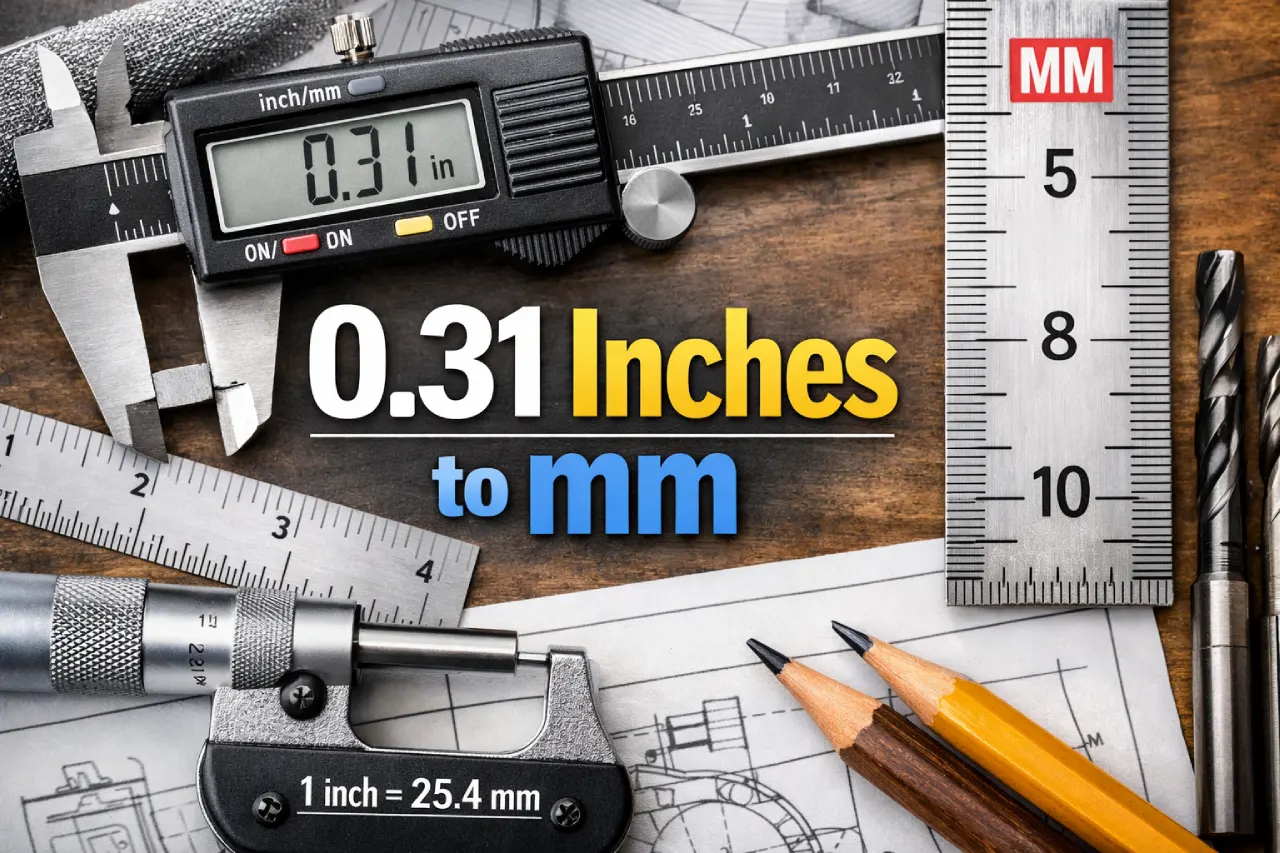
0.31 inches = 7.874 millimeters
That number is not a rough estimate. It comes from the exact, internationally accepted conversion between inches and millimeters.
But if you stopped reading there, you’d miss the part that actually makes this useful.
When people search for “0.31 inches to mm,” they’re usually trying to understand more than just the math. They want to know how big this measurement really is, why it appears so often in specs, how close it is to common metric sizes, and whether rounding it is safe.
This article breaks all of that down in a way that’s practical, clear, and easy to remember.
Why “0.31 Inches to mm” Is Such a Common Question
Inches and millimeters constantly cross paths.
In the U.S., inches are still common in construction, woodworking, and everyday measuring. Millimeters dominate engineering, machining, electronics, manufacturing, and global standards.
So a measurement like 0.31 inches often shows up in:
- Engineering drawings
- CAD and CNC files
- Tool specifications
- Product dimensions
- International parts lists
The moment someone needs to match that number with metric tools or components, the conversion becomes essential.
The Exact Conversion Formula (No Guesswork)
Every inch-to-millimeter conversion uses one fixed rule.
1 inch = exactly 25.4 millimeters
This is a defined standard, not a rounded value.
So the formula is simple:
millimeters = inches × 25.4
Now apply it.
0.31 × 25.4 = 7.874
That gives us the exact result:
0.31 inches = 7.874 mm
Why This Conversion Is Exact
Some inch-to-millimeter conversions result in repeating decimals or long strings of numbers. This one doesn’t.
That’s because:
- 0.31 inches = 31/100 inch
- 25.4 mm per inch is exact
The math lands cleanly at 7.874 mm, with no rounding required unless you choose to round for convenience.
Visualizing 7.874 mm in Real Life
If millimeters don’t come naturally to you, here’s how to picture 7.874 mm.
It is:
- Just under 8 millimeters
- Slightly thinner than a standard pencil
- About the width of a small USB plug
- Smaller than a dime’s thickness
It’s a compact but very common size in mechanical and electronic components.
Is 7.874 mm Basically the Same as 8 mm?
This is a fair question, and the answer depends on context.
The difference is:
- 8.000 mm − 7.874 mm = 0.126 mm
- That’s about 0.005 inches
For:
- Rough DIY work
- Visual layout
- Non-critical spacing
Rounding to 8 mm may be acceptable.
For:
- Machining
- Precision assemblies
- Tight tolerances
That difference matters.
So:
- 7.874 mm is close to 8 mm
- But it is not the same measurement
Understanding 0.31 Inches on Its Own
Before converting, it helps to understand the inch value itself.
As a fraction:
- 0.31 inches = 31/100 inch (exact)
That fraction doesn’t simplify into a clean ruler fraction like 1/4 or 5/16. That’s why 0.31 inches usually appears in digital readouts rather than on tape measures.
Where 0.31 Inches Sits on a Ruler
If you’re trying to visualize 0.31 inches on a ruler, here’s the mental picture.
Nearby common fractions are:
- 5/16 inch = 0.3125
- 19/64 inch = 0.296875
- 3/8 inch = 0.375
0.31 inches falls:
- Just slightly below 5/16 inch
- Well above 19/64 inch
- Far below 3/8 inch
On a ruler marked in sixteenths, it’s almost exactly at 5/16 inch, but just a hair smaller.
Closest Common Fraction to 0.31 Inches
For practical measuring, most people want the closest fraction.
5/16 inch = 0.3125
0.31 inches = 0.3100
Difference = 0.0025 inches
That’s very small.
So for most hands-on work:
0.31 inches ≈ 5/16 inch
For precision work, always stick with the decimal.
Why 0.31 Inches Appears So Often in Specifications
Decimal values like 0.31 show up frequently because:
- Software works in decimals
- Calculations are faster
- Scaling is easier
- Fractions can introduce rounding errors
Engineers and designers often think in fractions but document in decimals. That’s why 0.31 inches appears so often in CAD files and technical drawings.
Common Mistakes When Converting 0.31 Inches to mm
Even straightforward conversions can go wrong.
One common mistake is using 2.54 instead of 25.4, accidentally converting inches to centimeters instead of millimeters.
Another mistake is rounding 7.874 mm to 7.8 mm without checking tolerances.
Some people also confuse 0.31 inches with 0.031 inches, which is ten times smaller and a completely different size.
Decimals demand attention.
Fraction, Decimal, and Metric Together
Seeing all three forms together makes the measurement easier to remember.
- Fraction: 31/100 inch
- Decimal: 0.31 inches
- Metric: 7.874 mm
They all describe the same physical length.
A Quick Estimation Trick (When Precision Isn’t Critical)
If you need a fast mental estimate:
Remember:
- 1 inch ≈ 25 mm
So:
.31 × 25 ≈ 7.75 mm
That’s close enough for quick checks. For exact work, always use 25.4.
Where This Measurement Is Commonly Used
You’ll encounter 0.31 inches (7.874 mm) in:
- Mechanical clearances
- Electronic component spacing
- Machined parts
- Industrial design specs
- Tool and fastener dimensions
Knowing the metric equivalent helps when mixing imperial and metric systems.
Comparison With Nearby Measurements
Context helps lock the scale into your memory.
0.30 inches = 7.62 mm
0.31 inches = 7.874 mm
0.3125 inches = 7.9375 mm
0.325 inches = 8.255 mm
This shows clearly where 0.31 inches fits in the metric world.
Why Small Differences Matter More Than You Think
A difference of 0.126 mm might sound tiny.
But in precision assemblies, that can cause:
- Poor fit
- Binding
- Misalignment
- Extra wear
Exact numbers exist for a reason.
When to Stick With Millimeters Instead of Inches
For measurements under an inch, millimeters often feel more intuitive.
They avoid awkward decimals, scale cleanly, and are the global standard in technical fields. That’s why engineering drawings almost always switch to millimeters.
Inches are great for everyday measuring. Millimeters shine when precision matters.
Real-World Example
Imagine a slot designed to be 0.31 inches wide.
If you substitute 8 mm, the slot becomes wider than intended. One part may still fit, but stacked tolerances can cause issues down the line.
Using 7.874 mm keeps everything aligned with the original design.
Quick Summary You Can Trust
Let’s lock it in clearly.
- 0.31 inches = 7.874 mm
- Exact conversion using 25.4
- Very close to, but not equal to, 8 mm
- Closest common fraction ≈ 5/16 inch
If you remember one number, remember 7.874 mm.
Final Thoughts
At first glance, 0.31 inches looks like an awkward decimal.
But once you understand how it converts to 7.874 mm and where it sits compared to common fractions and metric sizes, the confusion disappears.
Measurements aren’t hard—they just need context. And once you have that, everything fits better the first time.