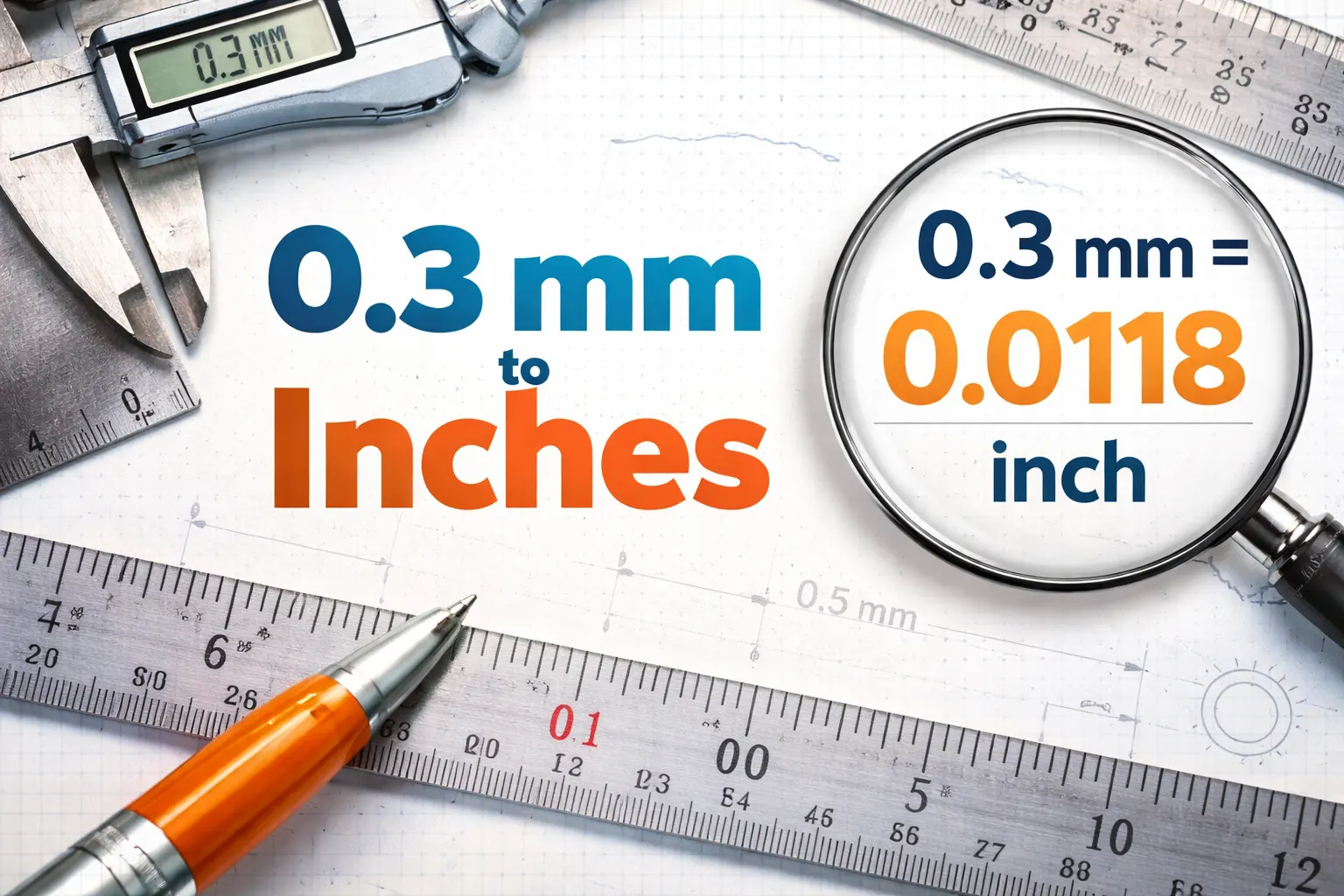
Let’s start with the answer you’re probably here for.
0.3 mm = 0.011811 inches
Rounded for everyday use, most people write it as 0.0118 inches.
That’s the exact conversion. But as with many tiny measurements, the number itself is only half the story. The real value comes from understanding where this measurement shows up, how small it truly is, and why it matters more than you might expect.
If you’ve ever paused over a spec sheet, a tool setting, or a design file wondering what 0.3 mm really means in inches, you’re in the right place.
Why People Search for “0.3mm to Inches”
Millimeters dominate precision work across the world. Inches still rule daily life in the U.S. When those two systems collide, conversions become unavoidable.
People usually look up 0.3 mm to inches when dealing with:
- Engineering and manufacturing tolerances
- 3D printing settings
- Wire thickness and sheet metal
- Jewelry components
- Mechanical clearances
- Medical or electronic parts
In these situations, being “close enough” often isn’t good enough.
What 0.3 mm Really Represents
A millimeter is already small. 0.3 mm is tiny.
To put it into perspective:
- It’s roughly three times the thickness of a human hair
- Thinner than standard paper
- Hard to distinguish on most rulers
- Common in fine adjustments and tolerances
When you convert it to inches, it becomes a decimal that looks almost meaningless unless you know how to read it.
The Exact Formula to Convert 0.3 mm to Inches
The conversion itself is straightforward and never changes.
1 inch = 25.4 millimeters
So the formula is:
Inches = Millimeters ÷ 25.4
Now apply it.
0.3 ÷ 25.4 = 0.01181102362
Rounded sensibly:
0.3 mm ≈ 0.0118 inches
If you’re working in high-precision fields, you may keep more decimal places. For most practical uses, four decimal places are more than enough.
Why 25.4 Is the Key to Every Conversion
The number 25.4 isn’t a coincidence. It’s an exact, internationally agreed standard.
Once you remember that one inch equals exactly 25.4 mm, conversions stop feeling like guesswork and start feeling logical. Every millimeter-to-inch calculation is simply a division by this fixed value.
How Small Is 0.3 mm Compared to Common Inch Fractions?
Most people in the U.S. think in fractions, not decimals, so comparisons help.
1/64 inch = 0.015625 inches
0.3 mm = 0.011811 inches
That means 0.3 mm is a bit smaller than 1/64 inch.
This explains why it’s nearly invisible on standard rulers. Even tools marked in sixty-fourths don’t quite capture it cleanly.
Why 0.3 mm Is Common in Precision Work
Despite its size, this measurement shows up often.
In 3D printing, 0.3 mm is a popular nozzle size and sometimes a layer height. In manufacturing, it’s a typical tolerance limit. In electronics, it can describe spacing or component thickness. In jewelry, it appears in wire gauges and fine settings.
Small numbers are where precision lives.
Common Mistakes When Converting 0.3 mm to Inches
Tiny values invite big errors.
One common mistake is rounding too early. Dropping .0118 inches to .01 inches changes the measurement by more than 15 percent.
Another mistake is confusing 0.3 mm with 3 mm. That missing decimal point makes the measurement ten times larger.
Some people also assume 0.3 mm is close to 1/32 inch. It’s not. 1/32 inch equals 0.03125 inches, which is almost three times larger.
A Simple Mental Math Shortcut
If you need a fast estimate and don’t need extreme precision, try this.
Divide the millimeter value by 25.
0.3 ÷ 25 ≈ 0.012 inches
That’s very close to the real value of 0.0118 inches. It’s not perfect, but it’s quick and surprisingly accurate for mental checks.
Conversion Table for Better Context
Seeing nearby values helps your brain understand scale.
0.1 mm ≈ 0.0039 inches
0.2 mm ≈ 0.0079 inches
0.3 mm ≈ 0.0118 inches
0.5 mm ≈ 0.0197 inches
1.0 mm ≈ 0.0394 inches
Once you see the pattern, conversions start to feel intuitive.
When Millimeters Are Better Than Inches
For very small measurements, millimeters are often easier to work with.
They avoid awkward fractions, scale cleanly, and are the global standard for technical work. That’s why CAD software, engineering drawings, and international manufacturing almost always default to millimeters.
Inches are great for everyday measuring. Millimeters excel when precision matters.
Real-World Situations Where 0.3 mm Matters
This measurement can be critical in situations like:
- Adjusting machine tolerances
- Setting up a 3D printer
- Selecting thin shims or spacers
- Designing tightly fitted parts
- Calibrating precision tools
Knowing that 0.3 mm equals about .0118 inches helps you make confident decisions instead of guessing.
Why Small Errors Multiply Quickly
A single 0.3 mm difference may not look dramatic. But stack several components together, and the error compounds fast.
Ten parts off by 0.3 mm create a 3 mm error. That’s more than 0.11 inches, which is absolutely noticeable and often unacceptable.
Precision isn’t about being obsessive. It’s about preventing small mistakes from turning into big problems.
Final Thoughts
Let’s lock it in clearly.
0.3 mm = 0.011811 inches
For everyday use, 0.0118 inches is perfectly accurate.
This tiny measurement plays a big role in tools, technology, and design work. Once you understand it, conversions stop feeling intimidating and start feeling logical.
Small numbers deserve respect. Especially when precision is the goal.